How Does the Government Pay for Free Public Transport?
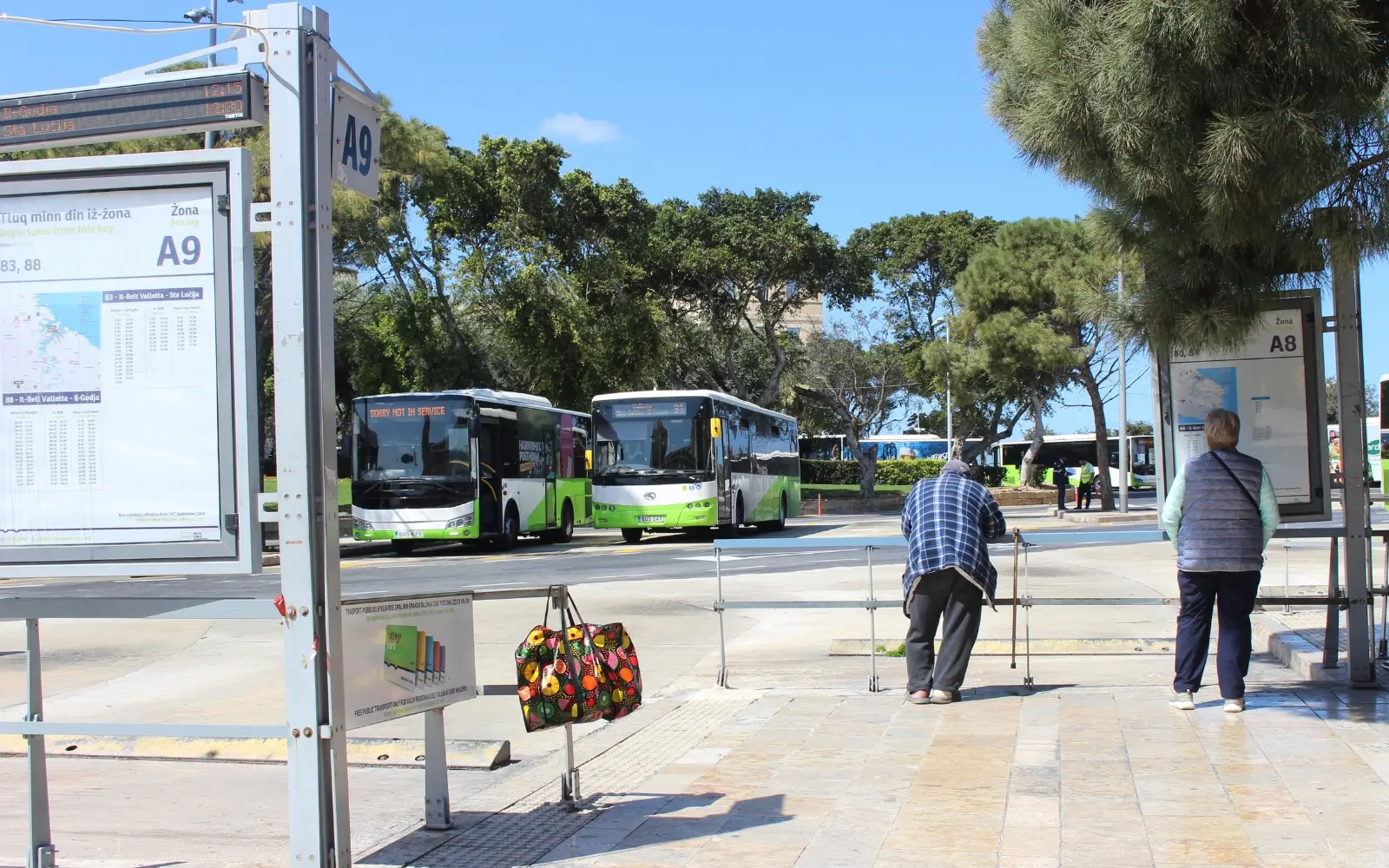
Malta’s free public transport system has been a cornerstone of the country’s sustainable mobility policy since 2022, costing €32.6 million in 2026 and over €125 million since its launch.
The 2027 Budget introduces a significant reform: removing tax-paying third-country nationals (TCNs) without a long-term residence permit (awarded to people who have lived in Malta for more than five years) from the benefit.
“There’s no logic behind it because it’s a lot of money,” says Patricia Graham, who leads the TCN Alliance Malta. “Foreign nationals coming to Malta have to have 110k [euro] health insurance, so they’re not getting free healthcare as is the myth. They pay for it. They don’t get access to rent subsidies. They spend. Some of them spend anything up to 12,000 euros to get here.”
The proposal is part of an overarching fiscal policy targeting TCNs in the 2027 Budget, which Prime Minister Robert Abela said sends a clear message about reducing dependency on foreign labour.
“We have clearly shown that we will never, ever go back on our word,” he said. But it marks a clear shift in policy, as in his New Year’s address in 2025, Abela praised free childcare and free public transport as “support measures that other countries can only dream of”. Less than two years later, the ‘dream’ support measures are being cut back.
The Momentum party has called the change “an unbearable burden on low-income earners”. Friends of the Earth Malta said the budget “recalls colonial apartheid”. Meanwhile, the Nationalist Party evaded Malta Today’s questions about whether it supports this change.
A representative from Malta Public Transport told Amphora Media that “Malta Public Transport is discussing the implementation of this measure with the Authority for Transport in Malta and the Ministry for Sustainable Mobility” and did not respond to whether the company was consulted in advance.
But how much is the government actually saving – and how has EU funding contributed to the project over the years?
Expanding free access
The government had been expanding free transport access over the years, covering full-time students, people with disabilities, and people aged over 75 years as of 2020. In 2022, it was extended to all taxpayers.
The rising passenger numbers are presented as evidence of the reform’s impact. The average daily passenger count rose from 157,286 in 2019 (the last full pre-COVID year) to 234,673 in 2026, for a total of over 82 million bus trips across 2025.
The population grew from 514,855 in 2019 to 588,257 in 2025, and tourist nights grew from over 19 million to over 25 million, meaning passenger growth far outpaced population growth and even tourism growth.
Passenger statistics do not distinguish between personalised Tallinja card users (residents) and tourists, who can buy a temporary card or pay drivers directly.
| Year | Average Daily Passengers |
| 2019 | 157,286 |
| 2020 | 92,539 |
| 2021 | 96,458 |
| 2022 | 134,856 |
| 2023 | 184,224 |
| 2024 | 207,598 |
| 2025 | 227,245 |
| January – June 2026 | 234,673 |
Budget documents show two main budget lines from the public transport system. The first is a public service obligation (PSO), compensation Malta Public Transport receives under its concession contract for running the network; the second is the Tallinja card, which covers free fares.
The public service obligation will reach €63 million in 2027, almost double the €34 million paid in 2021. The largest increase occurred in 2024, when the budget item rose by roughly €12 million that year.
A Spanish contractor won the tender to run Malta’s public transport in 2015. The National Audit Office flagged irregular negotiations between Transport Malta and the contractor. Amphora Media has reported on suspicious transactions between companies linked to Spanish contractors, officials and intermediaries. Nobody has been charged with wrongdoing in relation to the alleged scheme, and Malta Public Transport has denied irregularities.
Cost-saving?
The Tallinja card will cost €8 million in 2027, down from €32.6 million paid in 2026. That figure suggests the government estimates the financial cost of TCNs using the free bus service at €24.6 million.
Budget documents show that the government’s expenses on the Tallinja card has steadily increased since it was introduced to the entire tax-paying public in 2022 – with its actual expenditure climbing roughly 4 million per year.
| Item | 2021 | 2022 | 2023 | 2024 | 2025 | 2026* | 2027* |
| Public transport public service obligation | 34,018,029 | 37,819,594 | 41,830,322 | 53,108,291 | 55,000,000 | 60,000,000 | 63,000,000 |
| Tallinja card | 2,307,358 | 4,969,374 | 27,546,120 | 31,200,847 | 34,298,272 | 32,600,000 | 8,000,000 |
*estimates
Malta’s EU Recovery and Resilience Plan, which totals €328 million in grants, included the reform to extend free public transport to all personalised Tallinja card holders.
This required an addendum to the concession agreement between the government and the private bus service operator, signed in September 2022. Free land and sea transport was introduced that October.
Budget documents show the Transport Ministry using the Recovery and Resilience Facility from 2023 to 2026. However, they do not list a separate expense category to cover free public transport.
The government receives the funds in instalments once it completes the planned reforms and provides proof to the European Commission. In other words, completed reforms unlock further funds.
The free public transport reform was included under the third instalment. To get the money, the government had to prove that the milestones (the planned changes) have been achieved and not reversed.
Malta unlocked a €48.7 million instalment tied to this and other milestones”, compared with total expenditure on Tallinja cards between 2023 (the first complete year of free public transport) and 2026, which exceeded €125 million. In 2026, Malta generated €20 million from the fund, up from €12.7 million the year prior.
In the proof of reform Malta provided to the European Commission, on which it based its assessment, the government showed that Tallinja cards will not be credited for scheduled bus trips and that the card “is accessible to every resident in Malta”.
It remains to be seen whether excluding TCNs reverses that milestone.
As discussions about the policy shift rage, Patricia Graham and the TCN Alliance are planning a quiet protest. “Certain entities said we need to go on strike, we need to do something, we need to protest. But at the same time, [TCNs] are very aware that if they were to take anything on like that, the likelihood is that they would lose their jobs.”
Instead, TCNs and allies will be joining the Green Ribbon campaign. “From the 16th of November through to the 20th of November, on each day we will make a visible protest. For instance, on one day, third-country nationals won’t use the bus. On the second day, we won’t shop. We won’t go into the stores. We won’t buy anything. There is a myth, and it’s a myth that’s fed by the government, that third-country nationals come here, earn money, and send it back to their own countries. Most of them can’t afford to do that.”
More to read
-

The lonesome deaths of Stephanie Rapa
-
-
Environmental
Green To Grey: Malta Lost Over 830,000 Square Metres Of Land To Development In Five Years
-
-
Environmental
Profit In Every Drop: The Companies Pumping Malta’s Groundwater For Free
-
-
Politics
Open Malta: A New Political Data Transparency Platform By Amphora Media
-
-
Environmental
Summer Heatwaves Killed An Estimated 150 People In Malta
-
-
Environmental

Malta’s Short Lets: More Listings, More Licences, Zero Revocations
-
-
Crime & Legal Affairs

MGA-Licensed Operator Linked To €5.86 Billion German Illegal Gambling Probe