Government Rejects Almost 900 Parliamentary Questions On Direct Orders

By Evy Coeckelbergs
The Maltese government has refused to answer almost 900 parliamentary questions on direct orders during the current legislature. Since 2022, it has failed to respond to a single question requesting a breakdown of the often-misused public spending mechanism.
Direct orders are a non-competitive method for spending taxpayers’ money. The National Audit Office has flagged the extensive use of direct orders and has called for them to be used solely in “exceptional circumstances”.
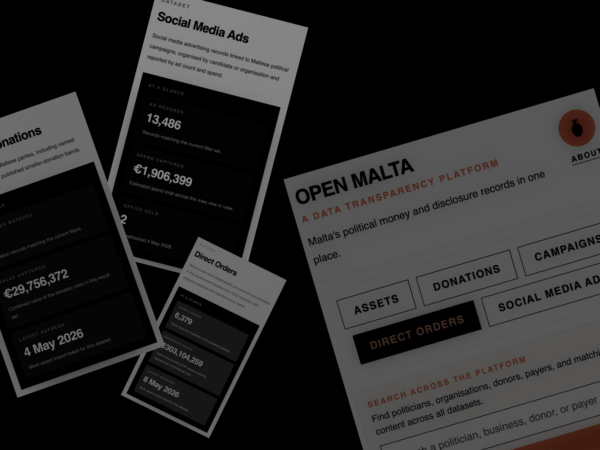
There is no official database of direct orders in Malta. Amphora Media, in collaboration with Transparency International, will publish a comprehensive breakdown of all direct orders and tenders issued from 2010 to 2025 across the administrations of Lawrence Gonzi, Joseph Muscat and Robert Abela in a new investigation tomorrow.
Before this current legislature, Ministers regularly provided breakdowns of the direct orders issued under their respective portfolios. However, since 2022, under the premiership of Prime Minister Robert Abela, at least 895 parliamentary questions asking for details on direct orders have been rejected.
A large number have been asked by PN MPs: Jerome Caruana Cilia (826) and Claudette Buttigieg (71). In nearly all the cases, the ministers relied on almost the same wording to justify their refusal:
“I inform the Hon. Questioner that the Contracting Authority publishes information in the Government Gazette for every procurement carried out for every six-month period, in accordance with Regulation 111(2) of the Public Procurement Regulations.”
“I have been informed that in order to provide the information requested by the Hon. Questioner, the advisory cost is exceeded.”
“When a government chooses silence instead of answering Parliamentary Questions, it undermines public trust and accountability. Refusing to reply to questions on direct orders raises serious concerns about openness and respect for democratic institutions,” Caruana Cilia told Amphora Media.

What does the law say?
The rules of parliamentary questions and answers are established under Standing Orders 27, which states that “the proper object of a question shall be to obtain information on a matter of fact within the special cognisance of the member to whom it is addressed.”
Under the rules, parliamentary questions are inadmissible if they publish a name; are inaccurate; are an attack on the personal character of an individual, among others.
Nowhere in the rules does it say that a question cannot be provided because of advisory costs.
Direct contracts, which are negotiated procedures without prior publication, are permitted under exceptional circumstances. In Malta, it has morphed into a key public spending mechanism.
By law, all direct orders are published in the Government Gazette to ensure transparency. In reality, the Gazette publishes the data biannually in the government gazette, and has become a cited reason for not answering parliamentary questions.
The government gazette – and the direct orders published within it – is a digital repository of lengthy PDFs, and key data can sometimes be missing. Amphora Media’s upcoming investigation has brought all of that data into one place.
“Public funds are not private resources; they belong to the people and must always be used for the common good. Citizens have a right to know how their money is being spent and what decisions are being taken in their name.” Caruana Cilia said.
“Transparency is not optional; it is the foundation of good governance. If there is nothing to hide, nothing should be withheld.”
More to read
-
-
Environmental

Profit In Every Drop: The Major Industries
-
-
Environmental
Profit In Every Drop: The Companies Pumping Malta’s Groundwater For Free
-
-
Crime & Legal Affairs
Listen: The Trial Against Yorgen Fenech – A Podcast By Amphora Media
-
-
Politics
Open Malta: A New Political Data Transparency Platform By Amphora Media
-
‘All Roads Lead To Keith’: The Defence’s Case In The Trial Against Yorgen Fenech
-
-
Crime & Legal Affairs
‘Your Fingerprints Are All Over This’: Cini Turns Fenech’s Own Account Against Him