Contract Splitting And A Time Magazine Feature: Over €17 Million In Direct Orders In Latest Dataset

By Daiva Repečkaitė, Sabrina Zammit, Evy Coeckelbergs and Julian Bonnici
A Time magazine feature. Comino ferry services. Contracts split or priced just cents below the threshold that would trigger further approval. Direct orders published in the first quarter of 2026 show how the government channelled nearly €17 million of taxpayers’ money through this uncompetitive procurement mechanism.
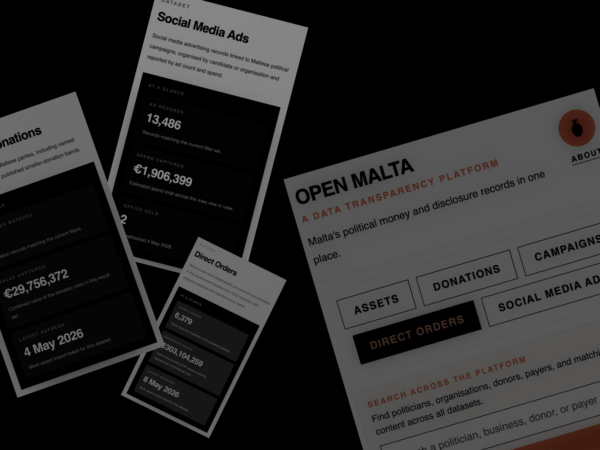
The latest data builds on an Amphora Media database that analyses all direct orders and tenders published between 2010 and 2025. While published in 2026, the most recent batch of direct orders were issued across 2024 and 2025.
The data does not include a reported €120 million negotiated procedure issued to Bonnici Bros for works at Mater Dei, under evaluation as of April.

Large contracts remain the norm
Schembri Barbros Ltd, which has overlapping shareholders with a company that donated to the Labour Party, received the largest single direct order in the latest dataset, receiving a €815,000 contract from Infrastructure Malta for restoration works on a promenade and quay.
In total, Schembri Barbros received over €833,000, while Bitmac Ltd, a company partly owned by Schembri Barbros, received the second-largest direct order, worth almost €669,000, for “Placing of Barriers along Vjal Ragusa”.
Companies owned by Barbros Group received over €2.4 million in direct orders over the 2010-2025 period, previously analysed by Amphora Media, including at least €182,000 under PN.
Schembri Barbros received €336,000, Schembri Concrete Blocks Ltd received over €32,000, and Schembri JV, linked to Barbros Group, received €3.1 million.
Schembri Barbros did not reply to Amphora Media’s questions.
Comino Ferries Co Op Ltd, a cooperative led by Captain Morgan Leisure Limited, received a €138,999.98 direct order from Transport Malta for the “transport of staff to Comino for 7months”.
This contract was just two cents less than the amount that would have required the director’s approval at the Department of Contracts.
Captain Morgan Leisure Limited is owned by Fortina Investments. Amphora Media has reported on prior payments between Fortina’s Edward Zammit Tabona and the former Transport Malta head, James Piscopo, as well as the substantial profit Fortina made from the sale of land acquired through a public concession.
Transport ministry and Comino Ferries Co-op did not explain how the amount was determined or whether any threshold manipulation occurred to avoid triggering the Department of Contracts’ involvement.
A Time magazine feature on a statement from the MFSA’s chairman also made the cut for direct order spending, costing the authority €39,000.
MFSA’s spokesperson said that “Time was selected based on its international reach, the relevance of the topics discussed, and its alignment with the Authority’s communication objectives. The associated cost was consistent with prevailing market rates”.

Chopping and cropping contracts
In other purchases, contracts were kept small to pass below additional scrutiny thresholds.
The Commission on Gender-based Violence and Domestic Violence (under OPM) issued a direct order of €9,999 to Tallinja Technology Limited for advertising on buses. Just an extra euro would have required approval from a minister, parliamentary secretary or another senior official.
Tallinja Technology and OPM did not reply to questions.
Multiple direct orders to the same contractor under the €10,000 threshold were observed as a pattern across several institutions. OPM issued three direct orders on the same day. The works would have required senior approval if they had been covered by a single direct order.
Separate direct orders one day apart, under the €10,000 threshold, were also issued by the Ministry for Foreign Affairs and Tourism. The Mediterranean Conference Centre, for which the works were contracted, said that “The orders in question are two separate contracts for the provision of different kinds of professional services”.
The Court Services Agency also issued linked direct orders 15 weeks apart and four direct orders to the same contractor – all under the threshold.
When contacted by Amphora Media, all involved contractors explained that the separate direct orders were for distinct services and that prices were set by the public bodies issuing them.
In an OECD review published in 2023, authorities explained that they resorted to direct orders because vetting of proper tenders was causing delays. OECD did not follow up to see whether its recommendations to improve the public procurement system were implemented.
More to read
-
-
Environmental

Green To Grey: How Is Land Take-Up Regulated?
-
-
Environmental

Green to Grey: When Development Creeps Up On Agricultural Land
-
-
Environmental
Infrastructure, Commercial Complexes, Cemetery: Satellite Data Reveals Malta’s Largest Green-to-Grey Areas
-
-
Environmental
Green To Grey: Malta Lost Over 830,000 Square Metres Of Land To Development In Five Years
-
-
Environmental
Profit In Every Drop: The Companies Pumping Malta’s Groundwater For Free
-
-
Crime & Legal Affairs
Listen: The Trial Against Yorgen Fenech – A Podcast By Amphora Media
-
-
Politics
Open Malta: A New Political Data Transparency Platform By Amphora Media
-

MGA-Licensed Operator Linked To €5.86 Billion German Illegal Gambling Probe