Lead Investigator Details Two-Year Trail From Bomb To Melvin Theuma’s Arrest And Pardon
Cover image by Anna Calleja
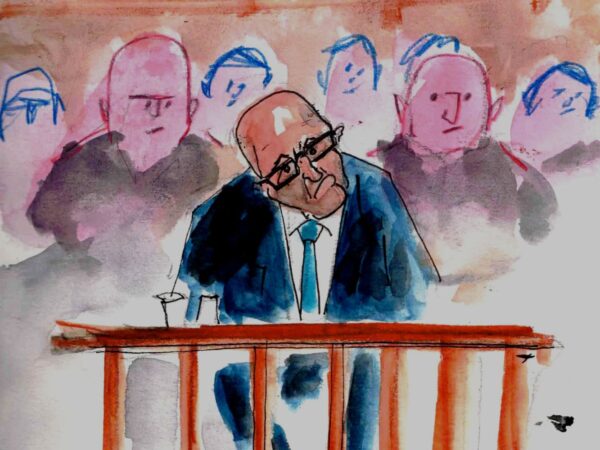
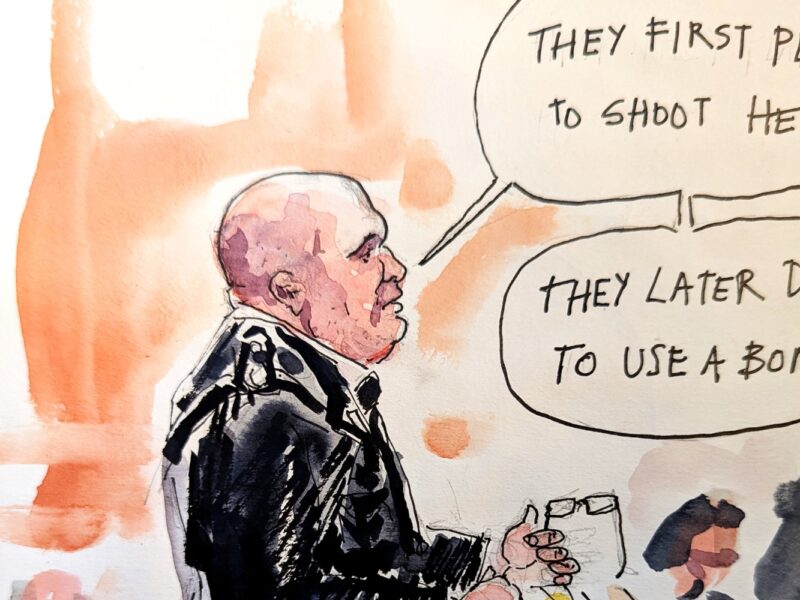
Assistant Commissioner Keith Arnaud, who led the investigation into the assassination of journalist Daphne Caruana Galizia, took the stand on the third day of the trial of Yorgen Fenech, walking jurors through more than two years of investigation, from the car bomb on 16th October 2017 to the agreement, signed on 19th November 2019, that turned middleman Melvin Theuma into a state witness.
His testimony, which took up the entire sitting, fell into three chapters: the forensic and telephony trail that identified the hitmen; the confession of Vince Muscat, which was promptly leaked to the killers; and the slow, deadlocked pursuit of Melvin Theuma that ended with an ice-cream box opened before a magistrate and the first appearance of Keith Schembri’s name in the investigation.
The bomb, the vantage point, and the phones
Arnaud, then an Inspector with the Homicide Squad, was among the first investigators on the scene. The priority, he said, was preserving it: nothing was touched until forensic experts arrived from abroad, with the FBI assisting on telephony and a Dutch team on scene evidence, and the AFM holding a perimeter.
The evidence showed the bomb had detonated from inside the vehicle – placed under the driver’s seat – and indications were that it had been triggered remotely. Caruana Galizia’s son Matthew told investigators his mother had just left the house for a bank appointment, briefly returning because she had forgotten her cheque book.
Working on the assumption that the killers had to have been watching the house, investigators identified a vantage point below the Victoria Lines from which, with binoculars, one could see right down to the gate of the Caruana Galizia residence. There they recovered a cigarette butt. After the arrests, its DNA profile was matched to Alfred Degiorgio.
A resident had repeatedly noticed a car parked nearby in the days before the murder – including that morning – with a partial plate ending in QZ. Police worked through every small car ending in those letters, eventually tracing it through leasing companies after several weeks.
With FBI assistance, investigators harvested data from every cell tower serving the crime scene. From thousands of numbers, they isolated one that went dead within a minute of the explosion, at 2.58pm, the same minute the victim’s own phone died.
That number’s SIM had been paired since January 2017 with a SIM900, a device used to remotely trigger electronics. The SIM was first activated in the area of the Ħaż-Żebbuġ industrial estate, near a garage held by Robert and Adrian Agius, known as tal-Maksar, pinged Santa Venera on 13th October, and was switched on in Bidnija at 1.40am on the day of the murder, after which it was never touched again. The post-blast expert reconstructed the SIM900 from debris recovered at the scene.
A second number sent the SMS that detonated the bomb. Its movements that day tracked along the coast towards the Grand Harbour, connecting to a cell tower facing the sea near the Lower Barrakka. Police pulled harbour CCTV and identified a boat matching the Maya, owned by George Degiorgio, idling below the bell for the five to ten minutes spanning the explosion. A comparative exercise on footage filmed by police on 21st November, when Degiorgio took the Maya out again, confirmed to a court expert it was the same vessel.
Degiorgio nearly failed. He ran out of credit on the detonation phone while at sea and had to ask a friend to buy him a top-up voucher, which he redeemed onto the burner. Three further burner phones — moving together, switched on and off together, active around Siġġiewi, San Pawl il-Baħar and, repeatedly, Bidnija — led investigators to the brothers George and Alfred Degiorgio and their associate Vince Muscat, known as il-Koħħu, whose personal phone moved in lockstep with one of the burners.
The three were arrested together at around 8am on 4th December 2017 at the Marsa potato shed, in an operation involving more than 100 officers, the AFM and five Europol experts flown in from The Hague. AFM divers later recovered seven mobile phones, vouchers and SIM starter packs from the seabed by the shed, among them Muscat’s personal phone and the phone used to send the fatal SMS. George Degiorgio’s own phone was found hidden under a floor panel; his partner’s number was written on his wrist.
“We ended up in a dilemma. Did they know we were coming?” Arnaud said. All three exercised their right to silence.
Police had by then also identified Robert Agius and Jamie Vella as suspected of procuring the bomb. Agius, his brother’s garage, and Vella’s premises in Mosta, another point overlooking Bidnija, were searched, though nothing was found.
Vince Muscat talks and the killers find out
The hitmen were in custody, but the motive was not established, and investigators wanted to know whether the three had been hired. They monitored the brothers in prison: visits, money, calls. One pattern stood out. On every call with their brother Mario Degiorgio, they asked after one person. In April 2018 the name slipped out on the line as beginning with “M”.
That same month, Vince Muscat’s then lawyer, Arthur Azzopardi, approached Arnaud: his client wanted to talk. Muscat was seeking a presidential pardon.
Arnaud met him discreetly at police headquarters on 23rd and 24th April 2018.
Everything Muscat said matched the evidence police already held: the vantage points, the burner phones, the rented white car with the leasing company’s sticker, the bomb under the driver’s seat.
He added what the data could not show: that the original plan was to shoot Caruana Galizia with rifles obtained from tal-Maksar, resting them on sacks in the fields, before switching to a bomb supplied by Robert Agius and Jamie Vella, who demonstrated how to trigger it by SMS. He described a garage in Mosta rented on a third party and another in Santa Venera rented under a false identity where the bomb was once kept; independently corroborating the SIM900’s Santa Venera ping of 13th October.
Muscat also described the money trail. In early 2017, Alfred Degiorgio had him drive to the Busy Bee in Msida, and returned saying he had met Melvin Theuma with a request to kill Caruana Galizia. George Degiorgio, whom Arnaud described as the group’s leader alongside his brother, set the price at €150,000, which was accepted. A €30,000 deposit was collected and split three ways; Muscat said he pulled out at one point and returned his €10,000, only to rejoin later. After the murder, he drove Alfred to Wied il-Għajn to collect the remaining €120,000. Each man’s final share was €50,000.
Crucially, Muscat never saw Theuma himself. Everything came through Alfred Degiorgio, which Arnaud said would amount to hearsay but it gave investigators the name behind the “M”: Melvin Theuma.
From then on, they watched Theuma become the brothers’ lifeline: the only person outside their families in constant contact, working through Mario Degiorgio, keeping them supplied and, in Arnaud’s telling, keeping them happy.
Then the investigation sprang a leak. Within days of Muscat’s meetings, Azzopardi returned in a panic: the hitmen knew Muscat had spoken to police. Prison phone intercepts confirmed it. Arnaud did not say how the information travelled.
Theuma, the recordings, the pardon and the ice-cream box
Muscat’s pardon request was discussed at a meeting in Castille days after he spoke, attended by then Prime Minister Joseph Muscat, the Attorney General, the Police Commissioner, minister Owen Bonnici and chief of staff Keith Schembri, and formally refused in October 2018.
Attention turned to Theuma, a taxi driver operating out of Portomaso. From the third week of May 2018, shortly after police began watching him, his behaviour changed sharply: swings between calm and desperation, panic, rage.
By June, investigators understood he was secretly recording conversations with someone who was causing him serious trouble, and confiding in his partner and friends including Edgar Brincat. The first indication that the person was Yorgen Fenech came in late June; it was only around October or November 2018 that police could confirm the issue was with Fenech, and that it concerned the Caruana Galizia case.
“We had a lot and we had nothing,” Arnaud told jurors. “Muscat’s account was intelligence, not evidence. The recordings might prove everything, or nothing, or entrapment , and police did not know what was on them or where they were kept. It was risk. If the search came up empty, the homicide investigation would have shown its hand to an alerted suspect. “
In June 2018, meanwhile, Arnaud’s superior on the case, Deputy Commissioner Silvio Valletta, was removed from the investigation by court order. From January 2019, Arnaud took the case over full-time.
The way out came from Theuma himself: he was not just a taxi driver but ran an illegal lottery. In March 2019 police settled on a plan endorsed by Europol: open a money laundering investigation through the Financial Crimes Investigations Department, led by Inspector Nicholas Vella. It would justify an arrest and property searches, letting police hunt for the recordings without revealing the homicide angle.
The FCID built its case through 2019 and set the arrest for Saturday 16th November, when Europol equipment for detecting hidden devices would be available. On the 14th, Vella called Arnaud: Theuma was arranging a truck to empty his Wied il-Għajn flat, where he ran the lotto. The plan was scrapped on the spot and Theuma was arrested that day, along with his partner, her daughter and Edgar Brincat, all on money laundering.
Arnaud had expected a tough guy. “The rage he had was frightening… but in front of me he was different. He came in crying, telling me he had been wanting to come to us for a long time,” he said.
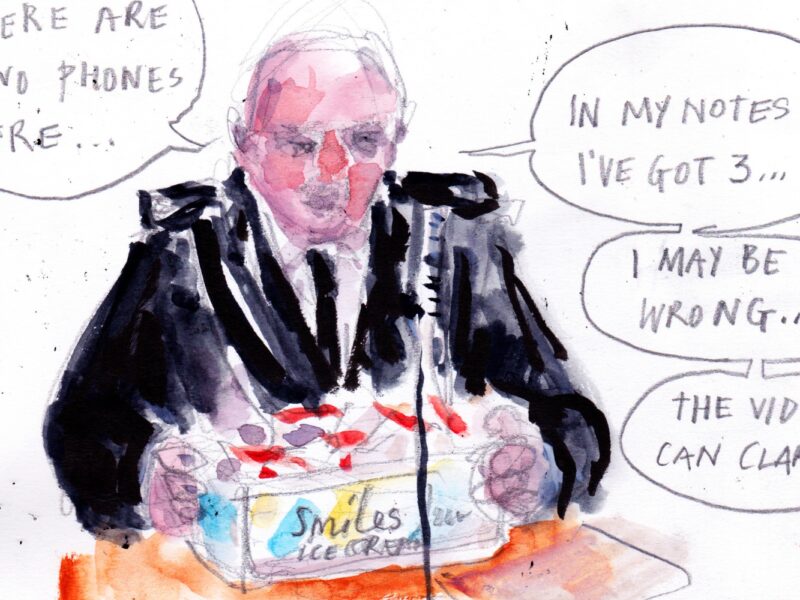
Theuma said he was ready to talk about the Caruana Galizia case but only with a pardon, because he trusted no one. He was clutching an ice-cream box he refused to hand over, insisting it contained everything.
The box was opened at 5.25pm before the inquiring magistrate, filmed by forensic officers, with Europol present. Inside: three Samsung mobile phones, a Philips voice recorder, three USB sticks, a USB cable, two bundles of rolled papers in rubber bands, and a folded set of around fifteen printed screenshots of mobile chats, plus a photograph of Theuma with Keith Schembri, then the Prime Minister’s chief of staff.
“Up to that moment, Keith Schembri’s name had not featured in the investigation,” Arnaud said.
Jurors were shown the photograph and the screenshots. One chat, on the Signal messaging app, contains the name “Yorgen”, misspelled, as Theuma always wrote it.
Theuma would say nothing of substance until his protection was formalised. The agreement, committing him to reveal everything he saw, heard and touched about the murder, including the executors and the money, was drafted on Saturday 16th November with the Attorney General’s office, the Commissioner and Theuma’s lawyers, and signed by the Prime Minister, the Attorney General and the Police Commissioner on Tuesday 19th November 2019. Only then did Melvin Theuma begin to talk.
He also provided receipts to show how he had paid the brothers to fund their legal defence.
The trial continues, with Arnaud expected back on the stand tomorrow. Fenech’s arrest, and what Theuma told investigators, is still to come.
More to read
-
-
Environmental

Green To Grey: Malta Lost Over 830,000 Square Metres Of Land To Development In Five Years
-
-
Environmental
Profit In Every Drop: The Companies Pumping Malta’s Groundwater For Free
-
-
Crime & Legal Affairs
Listen: The Trial Against Yorgen Fenech – A Podcast By Amphora Media
-
-
Politics
Open Malta: A New Political Data Transparency Platform By Amphora Media
-
-
Environmental
227 Million Litres For Free: Polidano Companies Top Malta’s Groundwater Users
-
-
Environmental
Profit In Every Drop: The Major Industries