Green to Grey: When Development Creeps Up On Agricultural Land
A satellite image from 2020 still shows fields in Qala, Gozo. By 2023, part of the land is already eaten up and cemented over, with two pools appearing instead. This development is one of many expanding into agricultural land identified in Amphora Media’s Green to Grey project.
“The countryside and coast remain two of the most important natural resources to conserve and protect from inappropriate development,” the 2006 Gozo and Comino Local Plan reads. It did not protect the agricultural land.
Agriculture is an environmental double-edged sword. On one hand, it is Europe’s largest contributor to biodiversity loss. On the other, half of all species in the EU rely on agricultural habitats.
According to the European Environment Agency, conversion of natural or semi-natural land (it includes cropland) into artificial surfaces “reduces ecosystem resilience by fragmenting landscapes, decreasing carbon storage and biodiversity capacity, increasing flood risk through higher surface run-off, and intensifying heatwave impacts in urban areas” while also decreasing quality of life.
A new investigation by Amphora Media, guided by Arena for Journalism in Europe and supported by The Malta Environment Foundation, reveals that Malta lost nearly 830,000 square metres to construction between 2018 and 2023. Since 2006, Malta has lost at least 1.94 square kilometres of green land.
A deep learning image recognition model compared satellite images over time and flagged land that appeared developed from above, with journalists manually removing incorrect data.
When reviewing satellite imagery, Amphora Media’s team found land in rural areas that was used for parking cars, boats, and other scrap material, unable to serve its ecological function.
Between 2012 and 2018, around 920,000 square metres were taken up, according to the European Environment Agency’s estimate.
Figures show that in nearly 95% of the take-up, farmland rather than natural area was affected. Around 26% of the Maltese islands’ area is covered by artificial surfaces, and almost 15% is built up as of 2022.
“We cannot continue to sacrifice agricultural land for short-term economic gains,” BirdLife Malta, an environmental NGO, said in response to a new agricultural policy document earlier this year.
Agricultural land in the city to be built over
Concerns about the loss of agricultural land boiled over again in a discussion about an application to develop a plot in Swatar, a highly urbanised area.
“Once again, the Planning Authority has chosen to side with developers instead of protecting the environment and the quality of life of residents,” the Momentum party said in a press release, reacting to the approval of the planning application.
“Beyond its agricultural value, this space plays an important role in the daily lives of residents. It offers a sense of openness in a dense urban environment, supporting both physical and mental well-being. It also serves a critical environmental function by absorbing rainwater runoff, helping to reduce flooding risks in surrounding areas, particularly in Msida,” Flimkien għal Ambjent Aħjar, an environmental NGO, said
Agricultural sector in decline
Declining farmland goes hand in hand with Malta’s dwindling agricultural sector.
Between 2018 and 2023, Malta produced nearly 8% less vegetables and 12.3% less fruit (by weight). Between the two last agricultural censuses, 2010 and 2020, Malta lost nearly one in six agricultural holdings and over 6% of utilised agricultural land.
When development competes with agricultural land, its prices only rise. According to the latest agricultural census, Maltese farmers have 10,731 hectares of farmland, and about half of it is rented from the government. Land purchase prices in Malta are by far the highest in the EU.
“In Malta, one of the smallest countries in the world, land comes at a premium, and access to land is very limited. So if you have a new farmer, it’s almost impossible to enter the sector because they don’t have access to land and water,” Malcolm Borg, who leads Ghaqda Bdiewa Attivi, told Amphora Media in a previous investigation.
Despite farmers asking for help to afford land, Amphora Media’s earlier investigation has shown that funds earmarked by the EU to support farmers are routinely directed to road-building in Malta.
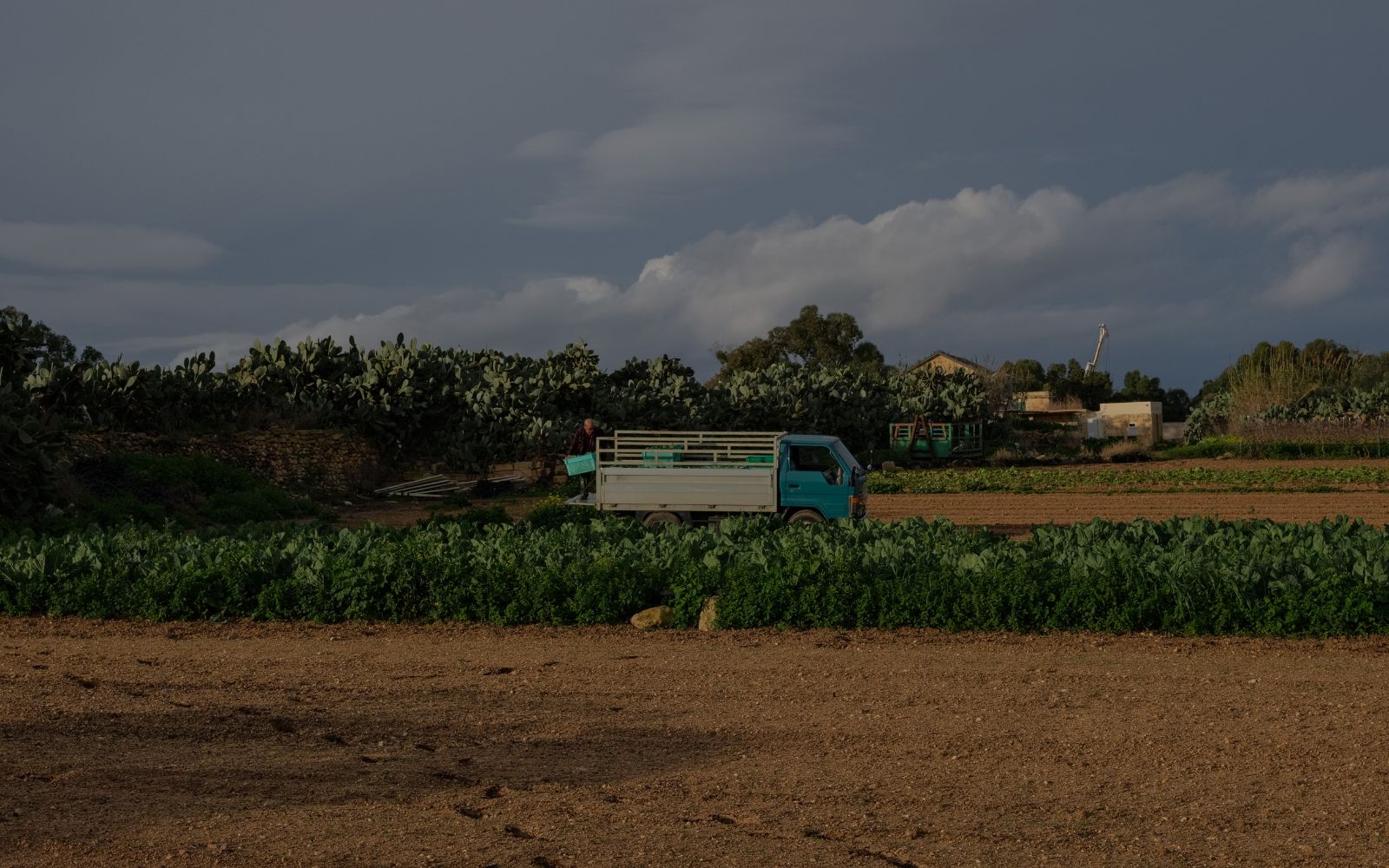
Cover image by: Joanna Demarco
More to read
-
-
Environmental

Infrastructure, Commercial Complexes, Cemetery: Satellite Data Reveals Malta’s Largest Green-to-Grey Areas
-
-
Environmental
Green To Grey: Malta Lost Over 830,000 Square Metres Of Land To Development In Five Years
-
-
Environmental
Profit In Every Drop: The Companies Pumping Malta’s Groundwater For Free
-
-
Crime & Legal Affairs
Listen: The Trial Against Yorgen Fenech – A Podcast By Amphora Media
-
-
Politics
Open Malta: A New Political Data Transparency Platform By Amphora Media
-
-
Environmental
227 Million Litres For Free: Polidano Companies Top Malta’s Groundwater Users
-
-
Environmental
Profit In Every Drop: The Major Industries