The Economic Contribution of TCNs in Malta

Malta’s 2027 Budget set third-country nationals in its crosshairs. Among a raft of measures, the government announced that TCNs living in the country on a single-work permit will soon face new charges and cuts.
For over a decade, foreign workers have driven Malta’s labour market. The Central Bank found they accounted for around three-quarters of employment growth since 2013. Yet, in its February 2026 assessment of Malta, the International Monetary Fund said the influx of foreign workers that fuelled growth has also strained infrastructure and public services.
But the proposals centre around one single question: what exactly is the economic contribution of TCNs in the country?
The proposals, set out in the 2027 Budget, include:
- The fee for a new work permit application rising from €600 to €800
- A new annual €400 “infrastructure contribution” on both new permits and renewals
- Public transport will no longer be free – with a new charge of 33 per month
- Childcare will no longer be free (this will not apply to children already in childcare)
- A new 83 monthly charge for a B or B1 driving licence, or €996 a year
- Loss of eligibility for the atypical in-work benefit, a €150 one-time payment for people working non-standard hours
*The exclusions from free transport, childcare and the atypical-work cheque apply to TCNs who have not lived in Malta for five years.
The work-permit charges are expected to bring in an additional €80 million, Finance Minister Clyde Caruana said. Combined, the public transport, childcare, licence and in-work benefit measures are expected to generate €46 million.
Caruana framed the measures as a matter of fairness, telling Parliament: “These pressures have a price. A price that, importantly, should not be borne only by Maltese and Gozitan taxpayers, but should be spread across those who are also a factor in this pressure.”
In 2017, the government simplified the procedures for employing non-EU workers and by 2018, the net immigration of non-EU nationals outnumbered EU nationals.
In an interview with The Malta Independent in 2018, Clyde Caruana, then chairman of JobsPlus, stated that Jobsplus was pursuing the employment of third-country nationals to sustain Malta’s economic growth and its pension system.
“If the economy continues to grow we will have to import foreigners no questions asked. If we don’t the economy will grow at a smaller rate,” he said.
The employment trends show a significant shift. Figures from Jobsplus show that the number of non-EU workers has climbed from 14,116 in 2017 to 94,130 as of December 2025, a near seven-fold increase.
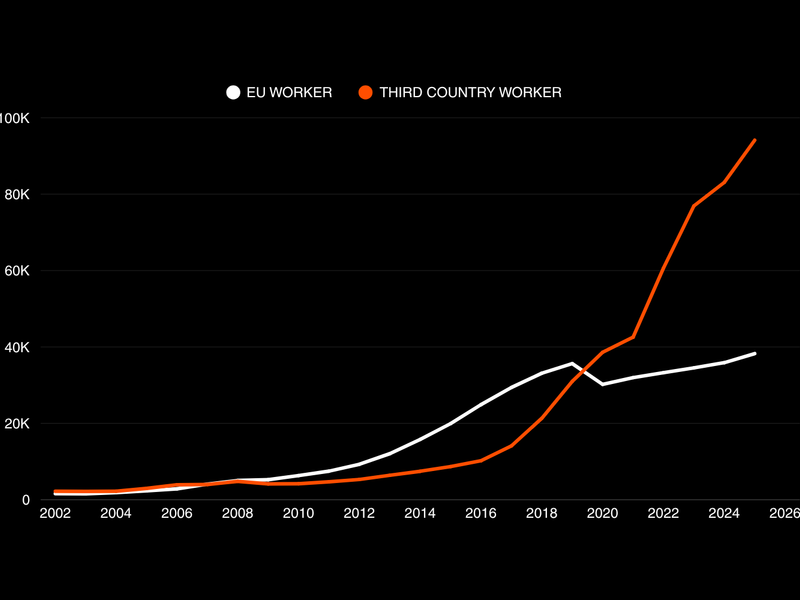
EU workers last outnumbered non-EU workers in 2019; non-EU workers also include UK nationals since 2020, who account for around 4,662 of today’s TCN workers but are not subject to the new proposals, along with citizens from the UAE and Andorra.
Robert Abela’s administration took office in January 2020. Since then, the number of non-EU workers has tripled, from 30,973 in 2019 to 94,130 as of December 2025. Over the same period, EU workers rose by just 7%, from 35,637 to 38,257.
As of December 2025, Indian nationals make up the largest group of TCN workers in the country (23,038), followed by Nepalese (13,901) and Filipinos (13,004).
| TCN – Top Nationalities | ||
| Rank | Country | Dec-25 |
| 1 | INDIA | 23,038 |
| 2 | NEPAL | 13,901 |
| 3 | PHILIPPINES | 13,004 |
| 4 | COLOMBIA | 4,950 |
| 5 | UNITED KINGDOM | 4,662 |
| 6 | SERBIA | 3,732 |
| 7 | ALBANIA | 3,215 |
| 8 | PAKISTAN | 3,048 |
| 9 | TURKEY | 2,750 |
| 10 | BANGLADESH | 1,985 |
By economic sector, most TCNs fall under “Professional, scientific, technical, administration and support service activities” (23,306), followed by wholesale and retail trade; transportation and storage; information and communication (19,844); and accommodation and food service activities (14,641).
Under the EU’s statistical classification of economic activities, temporary employment agencies sit within administrative and support services. According to figures tabled in Parliament in February 2026, some 16,804 TCNs are employed through agencies, nearly one in five TCN workers.
In fact, most TCN workers are in elementary occupations (24,259) and services and sales (22,932), together just over half the total.
TCN BREAKDOWN BY ECONOMIC SECTOR
| Sector | Number |
| Professional, scientific, technical, administration and support service activities | 23,306 |
| Wholesale and retail trade; transportation and storage; information and communication | 19,844 |
| Accommodation and food service activities | 14,641 |
| Construction | 9,853 |
| Manufacturing, quarrying and utilities | 8,446 |
| Public administration, defence; education; human health and social work activities | 8,222 |
| Arts, entertainment and recreation | 3,943 |
| Financial and insurance activities; real estate activities | 2,881 |
| Other services | 2,517 |
| Agriculture, forestry and fishing | 477 |
| Employed Third Country Nationals by Major Occupation Group | |
| Economic Sector | Year | Dec-25 |
| [1] Managers | 3,965 |
| [2] Professionals | 7,660 |
| [3] Technicians and Associate Professionals | 9,966 |
| [4] Clerks and support workers | 7,875 |
| [5] Services and sales workers | 22,932 |
| [6] Skilled Agricultural, fishery and forestry workers | 329 |
| [7] Craft and related trades workers | 9,435 |
| [8] Plant and machine operator and assemblers | 7,709 |
| [9] Elementary Occupations | 24,259 |
What TCNs pay
Malta’s tax revenues have soared since 2017, rising from €3.3 billion in 2016, the year before the shift in policy, to €7.4 billion in 2025. Direct taxes, which make up 51% of the overall tax revenue, reached €3,7 billion in 2025, up from €1.3 billion in 2016, while social contributions rose from €639 million to €1.2 billion.
That growth cannot be attributed to TCNs alone. Direct taxes include corporate tax from gaming, financial services and other sectors, and all revenue has been lifted by a growing economy.
Malta has no specific database of TCNs’ tax & NI contributions. However, in reply to a parliamentary question in November 2023, Finance Minister Clyde Caruana tabled figures showing that 60,457 TCNs had contributed over €85 million in personal income taxes, roughly €1,413 per TCN. The reply did not say which year the figures covered.
A Central Bank discussion paper published in April 2026 found that TCN pay consists almost entirely of basic wages. Basic wage is the base on which social security contributions are calculated. Among Maltese workers, by contrast, a growing share of pay comes as bonuses, allowances and other income on which no contributions are paid.
Many TCNs also leave before they could qualify for a pension. A separate 2025 Central Bank study found that nearly a third of foreign workers leave Malta within their first year of employment, and around half within three years.
The April 2026 paper also found that the median wage of a TCN who worked full-time for a full year in 2024 was €18,200, the lowest among the Maltese (32,500) and EU/EEA (32,700) cohorts, and well below the national median of 29,137, roughly 38% lower than the average.
Only 46% of TCN full-timers paid social security contributions for the whole of 2024.