In Malta’s Overcrowded Prison, Foreigners Make Up the Overwhelming Majority of Long-Term Pre-Trial Detainees

By Joanna Demarco
Part one of a two-part investigation with Italian partners Prismag, supported by Journalismfund Europe and guided by Italian criminal law expert and academic Dr Francesca Vitarelli, and journalist Inga Springe.
Key Findings:
- Out of the 810 inmates in Malta’s prisons, 340, or 41.98%, were awaiting trial.
- Foreign nationals made up just over half of the total prison population, and around two-thirds of detainees who were awaiting trial.
- Foreign nationals made up 66 of the 76 inmates, or 87%, who spent a year or more in pre-trial detention.
- Only 10 Maltese nationals were detained waiting for trial for that period – less than 8% of all Maltese inmates awaiting trial.
- 73% of detainees admitted to Mount Carmel’s Forensic Unit were in pre-trial detention.
- Electronic tagging, introduced in January, is being used in 11 cases, largely by Maltese nationals.
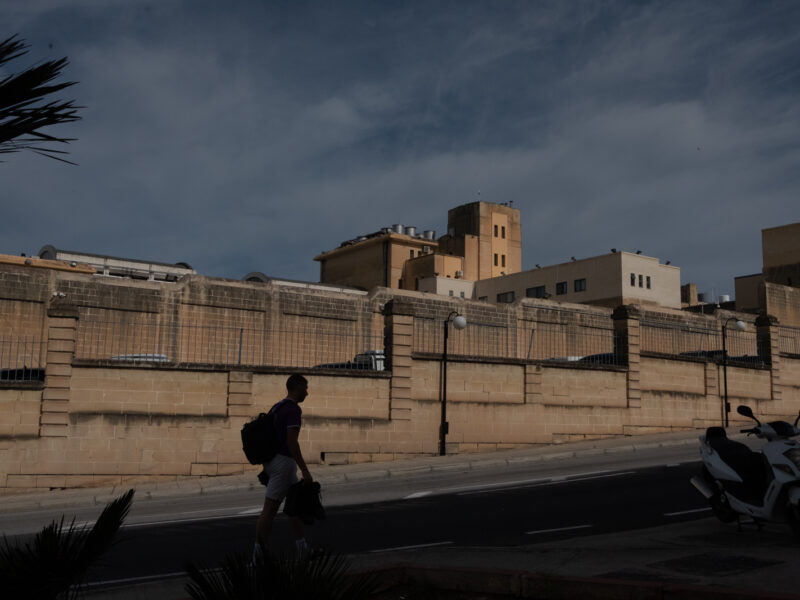
Malta’s main prison – Corradino Correctional Facility – was built to accommodate around 400 inmates, yet it currently houses double that amount, Home Affairs and Security Minister Glenn Beddingfield told Times of Malta last month, following his decision to deport foreign nationals before their prison sentences had ended.
In October, the population within the building – a 19th-century Victorian structure located just off a busy road and between a Basilica and the country’s only purpose-built mosque – stood at 746 inmates (810 across all correctional facilities), according to information provided to Amphora Media by the Home Affairs Ministry through a freedom of information request.
This overpopulation within prison walls does not exist in isolation. Malta’s population has increased by over 100,000 people in a decade according to the most recent census (2021), and its criminal justice system retains its spot as one of the slowest in the European Union, where criminal cases with a potential sentence of over two years have an average disposition time of 3977 days, almost 11 years.
This lag keeps many accused persons in pre-trial detention for long periods, despite their presumption of innocence. A European Commission recommendation lists pre-trial detention as a “measure of last resort”.
Of the 810 inmates in Malta’s prisons (including the Young Persons Offenders Unit in Mtahleb and the Forensic Unit in Mount Carmel), 340, or 41.98%, were awaiting trial. The percentage of pre-trial detainees has steadily increased since 2017, consequently placing Malta among the European countries with the highest proportion of pre-trial detainees.
The 2025 Council of Europe Annual Penal Statistics Report puts the cost of an inmate or detainee at €141.98 per day. Based on this amount, it would cost €48,273 per day for the current population of pre-trial detainees, or almost €1.45 million a month.
Amphora Media’s investigation found that almost 10% of the prison population has been awaiting trial for between one and five years, and almost 9 in 10 of that 10% are foreign nationals – who make up the majority (51.2%) of Malta’s total prison population.
The findings form part of a cross-border investigation called Justice Delayed, Equality Denied, into pre-trial detention and how strained, inefficient justice systems subject foreign nationals to systemic, indirect discrimination.
Foreign Nationals More Likely to Experience Long-Term Pre-Trial Detention
Through numerous freedom of information requests, Amphora Media obtained population data from Corradino Correctional Facility and Malta’s other correctional facilities to understand the current reality of pre-trial detention.
From data provided in October, 340 people detained in Malta’s prison were awaiting trial. Of these, 213 (63%) were foreign nationals and 127 (37%) Maltese.

The data also shows that foreign nationals are more likely to have been held for a year or longer. In fact, foreign nationals are nearly four times as likely as Maltese nationals to be held for a year or longer. They make up 66 of the 76 inmates, or 87%, who have spent a year or more in pre-trial detention. Only 10 Maltese nationals have been detained awaiting trial for that period of time – less than 8% of all Maltese inmates awaiting trial.
Of the 213 foreign nationals awaiting trial:
- 70 have been held for less than three months
- 77 for between three months and a year
- 39 for between one and two years
- 26 for between two and five years
- one, a Somali national, for more than five years
The picture is very different for the 127 Maltese awaiting trial:
- 67, more than half, have been held for less than three months
- 50 for between three months and a year
- 6 between one and two years
- 4 between two and five years
- none for more than five years
It is also worth noting that most foreign detainees in pre-trial detention– 158, or 47% of the total – come from outside of the European Union. The other 55 out of the 213 (16%) are from the EU, EEA, or Switzerland. The largest group of non-Maltese nationals in pre-trial detention is Somali nationals, with 21 people awaiting trial. Next come Libyans (19), Syrians and Italians (17), and Romanians (16).
One reason that prison and pre-trial detention numbers are disproportionately higher for foreigners could be that foreign nationals are less likely to be granted bail. According to a 2022 Country Report on Human Rights Practices by the U.S. Department of State, Malta’s Courts rarely granted bail to foreigners.
Beth Cachia, the Outreach and Research Officer at JRS Malta, told Amphora Media that non-Maltese nationals are not automatically denied bail, but migrants often face greater obstacles because courts consider risks such as absconding, unstable living conditions, and limited financial means or guarantors. She explained that migrants without permanent residence, family, long-term employment, or other strong ties to Malta may be seen as more likely to leave. She said this reason is used “very freely” to justify detention and not granting bail. Moreover, enforcement, such as reporting to a police station, may be more challenging if a person has an unstable living situation.
Cachia pointed out that when it comes to having the necessary financial resources or guarantors for bail, “Maltese defendants may be more likely to have relatives, employers, or community members willing to act as guarantors or provide assurance that they will comply with bail conditions.”

What does the law say about length of pre-trial detention?
Malta’s Criminal Code governs the maximum time a person can spend in pre-trial detention before they must be granted bail.
The law sets different limits depending on the seriousness of the alleged offence: a person may be in pre-trial detention for up to 12 months where the offence carries a sentence of less than four years, up to 16 months where it carries between four and nine years, and up to 20 months where it carries nine years or more.
Once that period expires without the prosecution filing the indictment or sending the accused for trial, the law requires bail. Further time limits apply after the compilation of evidence stage, ranging from four months to 30 months, again depending on the maximum penalty for the offence and its severity.
73% of Detainees Admitted to Mount Carmel’s Forensic Unit were in Pre-Trial Detention
The prolonged periods of uncertainty during pre-trial detention can have a significant impact on a person’s mental health, potentially resulting in long-term psychological consequences, Yanika Tabone, a psychologist working at RISe Foundation, a local organisation supporting the rehabilitation and reintegration of individuals within the criminal justice system, told Amphora Media.
“Living for prolonged periods in this fight-or-flight state, characterised by heightened physiological arousal, can affect a person’s neurological and biological functioning,” she explained, adding that chronic stress can interfere with cognitive functioning, emotional regulation and everyday decision-making, while contributing to persistent anxiety, depressive symptoms and feelings of helplessness.
Tabone further explained that these effects may intensify when individuals face additional uncertainty about possible deportation and their future.
She also highlighted the challenges faced by individuals who are ultimately acquitted following pre-trial detention, noting that compensation is not automatic and that the experience may continue to affect their employment opportunities, personal relationships and ability to rebuild their lives.
Data obtained by Amphora Media from the Home Affairs and Security Ministry on the Forensic Unit, a specialised unit within Mount Carmel for inmates needing treatment for psychiatric care, shows that pre-trial detainees make up the majority of admissions as of October 2026.
The data shows how, between 2021 and 2025, 1015 inmates were admitted to the Forensic Unit. Of these, 743 (73%) were still awaiting trial.
| Year | Total admissions | Pre-trial detainees | Sentenced | Pre-trial share |
| 2021 | 165 | 125 | 40 | 75.8% |
| 2022 | 225 | 163 | 62 | 72.4% |
| 2023 | 222 | 167 | 55 | 75.2% |
| 2024 | 204 | 140 | 64 | 68.6% |
| 2025 | 199 | 148 | 51 | 74.4% |
| Total | 1,015 | 743 | 272 | 73.2% |
In general, Maltese nationals were more likely to be admitted to the Forensic Unit each year. Between 2021 and 2025, about 66% of admissions to the Forensic Unit were Maltese nationals. However, the data does not indicate whether this percentage were in pre-trial detention or sentenced.
Meanwhile, the Correctional Services Agency has increased the number of psychologists providing services within Maltese prisons significantly over the past few years – from 10 in 2021 to 20 in 2025, according to information provided by the agency.
The parallel investigation by our Italian partner Prismag also found a strong correlation between foreign nationals, longer periods of pre-trial detention and a negative impact on mental health. In 2025, 74 inmates died by suicide in Italian prisons, and the data suggests that people awaiting trial face a much higher risk than those already definitively convicted – about 21 suicides per 10,000 defendants, or 83.4% higher than among convicted prisoners.
Moreover, foreign nationals awaiting trial were found to be especially vulnerable: their estimated suicide rate is 157.7% higher than that of Italian defendants, with roughly 35 suicides per 10,000 foreign defendants, compared with nearly 14 per 10,000 Italians, despite foreigners making up less than a third of the overall prison population.
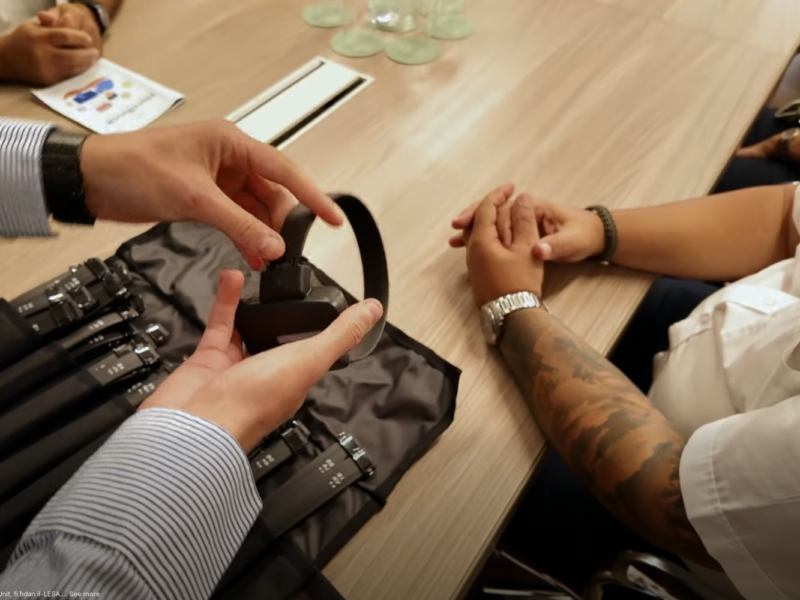
Electronic Tagging Being Used for Prison Leave, Protection Orders
The disparity in treatment between foreign and local inmates extends beyond pre-trial detention. Electronic tagging in Malta as an alternative to detention came into effect in January 2026.
In a 2025 report following its most recent fact-finding mission, the European Committee for the Prevention of Torture and Inhuman or Degrading Treatment or Punishment had encouraged the government to use electronic monitoring as one of the measures to reduce the number of pre-trial and short-sentenced prisoners.
Information obtained from the Local Enforcement System Agency (LESA) in September reveals that electronic tagging has been implemented 11 times: 9 times to Maltese nationals and twice to non-Maltese nationals; less than 1.5% of the current population at Corradino.
The electronic tagging systems are being used by Maltese nationals for prison leave (6)) and for a protection order while on pre-trial (3). The two non-Maltese cases are being used while on pre-trial following a protection order by the court.
Amphora Media sent questions to the Minister of Home Affairs and Security, Glenn Bedingfield, the Minister for Justice, Research and Innovation, Clifton Grima, the Minister for Equality and Civil Rights, Rosianne Cutajar and the Minister for Health, Ian Borg. No replies were received at the time of publication. Amphora Media also requested an interview at, and access to, Corradino Correctional Facility. The emails were not responded to.
Sabrina Zammit and Julian Bonnici contributed to this investigation with research support and editorial guidance.
This investigation was developed with the support of Journalismfund Europe.

More to read
-
-
Politics

Malta Will Charge Tourists €213 Million; Most Will Be Spent On Marketing Malta To More Tourists
-
-
Politics
Malta’s Bus Fees for Foreign Workers Could Lead to EU Recovery Fund Cuts
-
-
Politics
The Economic Contribution of TCNs in Malta
-

Amphora Media Team Wins Five Prizes At Malta Journalism Awards