2026 Election Guidebook: Energy
A voter’s guide to the choices facing Malta as the global cost of energy – and shielding the country from it – moves to the centre of the campaign
In a national address, Prime Minister Robert Abela called a snap general election for 30th May, citing an “extraordinary international situation”, particularly “energy”.
Russia’s war against Ukraine, the US-Israeli conflict with Iran, and rising tension around the Strait of Hormuz have pushed energy to the top of the international agenda, and, with it, the local one. Oil-based chemicals are in short supply, not just for energy but also for cosmetics, fertilisers, and plastic.
Maltese households have been largely shielded from the price shocks felt elsewhere in Europe, cushioned by Energy Support Measures expected to cost taxpayers roughly €1 billion by the end of 2026.
Beyond that, Malta’s experiences with blackouts – most notably in 2023 – have raised concerns over the long-term suitability of the country’s energy grid, and the investment needed to match supply with population and tourism growth.
The issue has been a key policy area that the PL and PN have tried to exploit, with Minister Miriam Dalli trading barbs with her counterparts over proposals.
Behind the back-and-forth lies an important question: what does Malta’s energy future look like?
Energy Support Measures: The €1 Billion Shield
Before the last general election, energy held its own dedicated ministerial portfolio.
Since 2022, however, it has been folded into Miriam Dalli’s expansive super-ministry covering Energy, Environment, and Public Cleanliness.
The ministry commands one of the largest budgets in government, with a projected annual expenditure of €767 million in 2026.
The Ministry is one of the largest spenders on direct orders and has maintained an uncompetitive public procurement system since Robert Abela became Prime Minister in 2020.
The United Equipment Co (UNEC) Ltd, part of Bonnici Group, was the top beneficiary, receiving over €32.2 million in direct orders for power generation, infrastructural works, industrial supplies, equipment procurement and more.
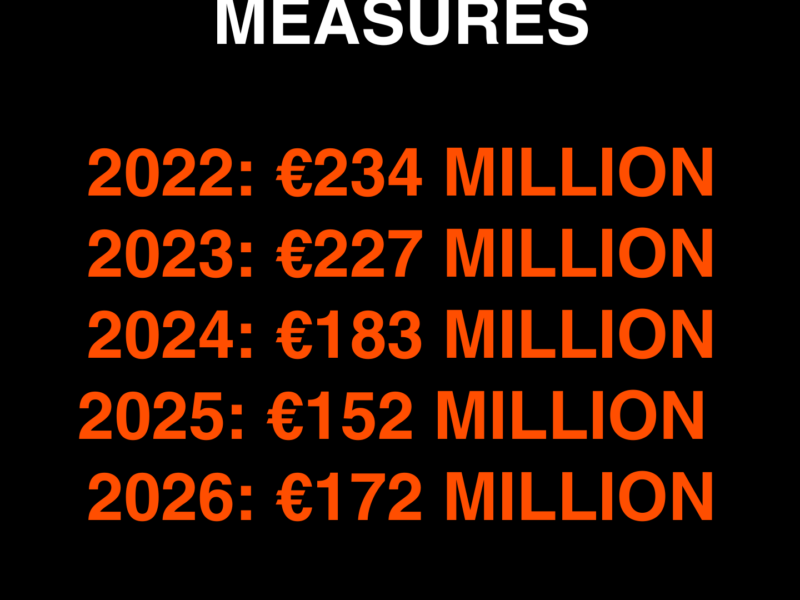
The Ministry’s single largest outlay is the Energy Support Measures – subsidies designed to shield households and businesses from rising global energy prices – projected at €172 million for 2026, following an actual spend of €183 million in 2024.
Malta introduced the subsidy in 2022 in response to surging international energy prices, triggered by the post-COVID economic rebound and the Russia–Ukraine war.
The mechanism is, in effect, a universal price freeze: the government issues direct grants to state-owned Enemalta (electricity) and Enemed (fuel) so retail prices remain pegged to 2014 levels, a “zero-energy inflation rate”.
It was accelerated in April 2022, when Malta’s long-term LNG hedging agreement expired. The country shifted from a fixed cost of €9.40 per unit of gas to a price indexed directly to Brent crude. That will expire in August 2026.
“Instead of passing increased energy prices on to consumers, the government decided to freeze retail energy prices by fully compensating the losses of the energy companies,” the IMF said in a country report.
The measures have worked as social policy. According to the Central Bank, they have prevented low-income households from bearing an inflationary burden roughly twice as heavy as that of wealthier households, because their energy spending is higher relative to their income and wealth. GDP in 2022 was around 1.2% higher than it would have been without intervention.
But the price has shown up in the public accounts. The European Commission has identified the measures as a primary driver of Malta’s national deficit, and the country was placed under an Excessive Deficit Procedure in 2024.
The EU uses this mechanism to ensure that members of the eurozone have sound public finances and one country’s overspending does not destabilise the entire currency area.
Continuing the subsidy, the Central Bank estimates, will add roughly 4% to Malta’s debt-to-GDP ratio.
The Central Bank has also warned of a less visible cost:: by holding prices artificially low, the subsidy mutes the very market signals that would otherwise push households and businesses to invest in energy efficiency or solar power.
It has called for a “phased and well-communicated exit” between 2025 and 2027, paired with targeted social support and stronger renewable incentives.
“[This] emerges as the most balanced path toward fiscal sustainability, energy efficiency, and environmental alignment with EU goals,” it wrote.
The Energy Transition:
Geography and density are part of the story. Malta has limited land for utility-scale solar, no operational offshore wind, and a grid that largely depends on LNG and an interconnector from Sicily. A second interconnector is on track to be finished by 2026, according to the government.
Malta’s transition to renewable energy has grown, but at a relatively sluggish pace. Malta’s renewable energy share is the third-lowest in the EU, and trails behind regional peers like Cyprus.
- 2022: 12.9% renewable energy
- 2023: 13.6% renewable energy
- 2024: 15.7% renewable energy
- 2025: 16.2% renewable energy
Malta has committed to hitting only 10% of its renewable energy benchmark, and its 2030 projections fall significantly short of EU requirements.
On paper, Malta’s climate performance appears strong. In 2023, Malta boasted the third-lowest net greenhouse gas emissions per capita in the European Union.
This success is largely due to the transition from heavy fuel oil to liquified natural gas and the launch of the Malta-Italy electricity interconnector.
The trajectory, though, is harder to assess. Malta recorded the fastest emissions growth in the entire EU between 2023 and 2024. That pace has since moderated, but total emissions continue to climb.
Energy production is the island’s leading source of pollution. Transport is also a top contributor.
Under the EU’s Effort Sharing Regulation, where most member states have committed to a 40% reduction in emissions by 2030, Malta negotiated a much more modest target of just 19%. The government said it considers that target too ambitious for Malta.
Who is using the energy?
Between 2022 and 2024, the top three energy consumers remained unchanged, with commercial and public services consistently leading, followed by households and the industrial sector.
Transport, despite being a lower-volume consumer, has seen the most dramatic relative growth, which correlates with the expansion of Malta’s electric car fleet.
| Rank | Sector | 2022 | 2023 | 2024 |
| 1 | Commercial & Public Services | 1,129.66 | 1,142.60 | 1,211.19 |
| 2 | Households | 1,031.67 | 1,019.48 | 1,086.34 |
| 3 | Industry | 485.09 | 482.04 | 497.04 |
| 4 | Transport | 10.86 | 18.35 | 23.63 |
| 5 | Agriculture & Forestry | 14.48 | 13.93 | 15.34 |
| 6 | Fishing | 37.88 | 3.13 | 3.43 |
What to watch for:
For voters cutting through the rhetoric, the questions that matter are simpler than the manifestos suggest. The €1 billion already spent on the shield was never put to a vote. The next billion will be, directly or otherwise.
Is any party prepared to say what happens to the subsidy? Is anyone pushing for new renewable capacity? Is the second (and the proposed third) Sicily interconnector the answer to resilience? Is the 19% emissions target being defended on its merits, or quietly conceded as one Malta will miss?
The shield has held this long. The election is about who carries it next and what, if anything, is being built behind it.
More to read
-
-
Environmental

Green To Grey: How Is Land Take-Up Regulated?
-
-
Environmental

Green to Grey: When Development Creeps Up On Agricultural Land
-
-
Environmental
Infrastructure, Commercial Complexes, Cemetery: Satellite Data Reveals Malta’s Largest Green-to-Grey Areas
-
-
Environmental
Green To Grey: Malta Lost Over 830,000 Square Metres Of Land To Development In Five Years
-
-
Environmental
Profit In Every Drop: The Companies Pumping Malta’s Groundwater For Free
-
-
Crime & Legal Affairs
Listen: The Trial Against Yorgen Fenech – A Podcast By Amphora Media
-
-
Politics
Open Malta: A New Political Data Transparency Platform By Amphora Media