2026 Election Guidebook: Population and Migration
A voter’s guide to where Malta actually stands on demographic growth, asylum and other types of migration.
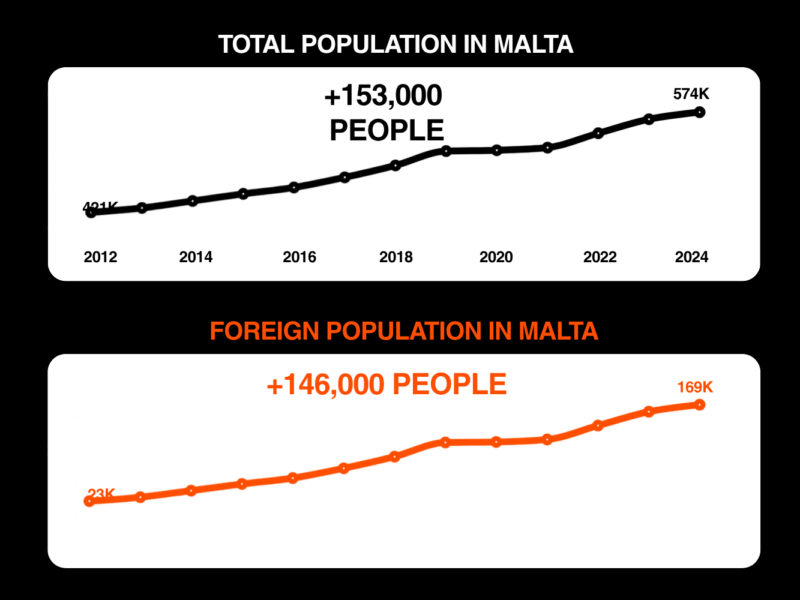
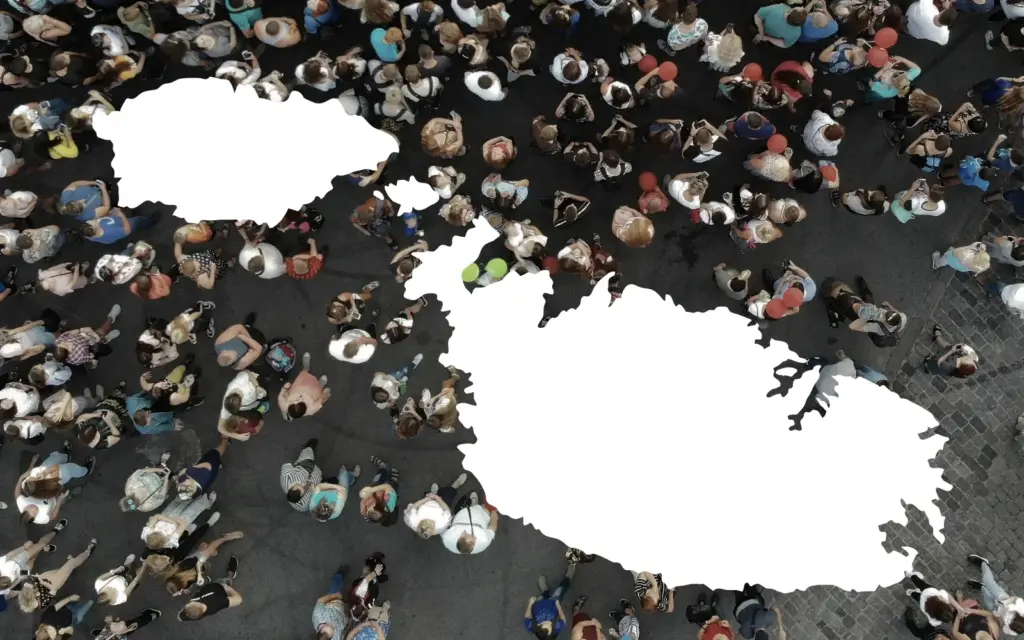
Malta’s population has ballooned: the latest census (2021) registered over 100,000 new people in a decade. By the end of 2024, the population stood at 574,250 – not including the 4 million tourists who arrived in Malta in 2025.
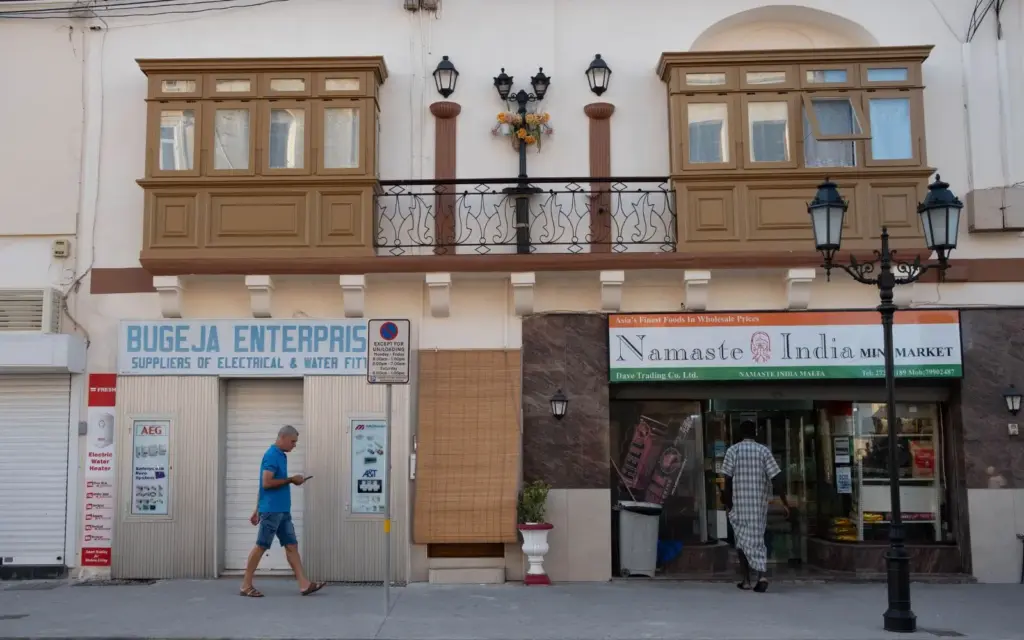
The foreign population has increased fivefold and now accounts for more than 20%, with Amphora Media’s Landscapes of Change project exploring how migration has reshaped various towns, while services, community infrastructure, police and integration policy have remained inadequate.
Concerns are compounded by Malta’s low birth rate, which is even lower among migrant residents than among native Maltese.
How much do voters care about migration and population?
Foreigners are often brought under one umbrella in Malta: whether they are EU workers, non-EU workers, asylum seekers, refugees or even tourists.
These differences may be difficult for people to unpick, making it challenging to measure public opinion on the varying forms of migration.
Migration makes some voters uneasy, but others accept it as an inevitable product of a booming economy – and, indeed, its building block.
In a 2024 survey, over 15% said that Malta needs foreign workers very much, and nearly 18% said it doesn’t need them at all. Over half said that bringing in foreign workers is the solution to a shortage of Maltese workers for certain jobs – that share rose to almost 60% in 2025.
“If the economy continues to grow, we will have to import foreigners, no questions asked. If we don’t, the economy will grow at a lower rate,” Clyde Caruana said before he became the finance minister.
Eurobarometer surveys have regularly placed migration among the top 5 concerns of Maltese residents. The Times of Malta’s surveys have ranked asylum and migration as the third-highest concern for respondents in 2025-2026.

The Key Migration & Economic Figures:
- Malta’s population has grown from 417,432 in 2011 to 574,250 in 2024.
- Malta issued over 326,000 single permits between 2015 and 2024 – these combine residence and employment rights. Nearly 9 in 10 single permit holders are in Malta for 12 months or more.
- As of 2024, 123,772 foreign nationals were working in Malta.
- Most migrant workers now come from non-EU countries such as India, Nepal and the Philippines (each over 10,000). The largest group of EU workers are Italians (12,000), followed by Romanians (over 2,700).
- A fifth of EU migrants were working in professional, administrative and related occupations. Nearly 15% are managers, and 7% work in elementary occupations.
- A quarter of third-country nationals (incl. UK and the USA) are in professional, administrative and related occupations; a fifth are in trade, transportation and IT. Only 4% are managers, and 27% work in elementary occupations.
- Population growth and migration have helped Malta more than double tax revenues between 2013 and 2023, alongside nearly doubling income tax and social security contributions.
- According to the Department of Industrial and Employment Relations, 218 companies and individuals are licensed to provide recruitment, temping and outsourcing services. These include Nigel and Mikaela Scerri’s Ennesse Ltd, numerous private security companies, Edward Zammit Tabona’s Ozo Group, and Malta Health Care Caterers, a beneficiary of substantial direct orders.
- The Malta Gaming Authority (MGA) reports that there were 7,554 non-Maltese workers in online activities licensed by MGA and 422 in casinos in 2024 – nearly three-quarters of all workers in both cases.
Asylum Seekers & Refugees
While voters feel uneasy but accept explosive population growth, politicians have repeatedly showcased a heavy-handed approach to asylum seekers.
Asylum seekers and refugees have different statuses from other TCNs. Asylum seekers are persons who have asked for protection, while refugees are those who were forced to flee their country and cannot return.
The contribution of asylum-related migration to overpopulation is negligible. Amphora Media’s research has shown that migrants passing through the asylum system are only one-tenth of all the foreigners living in Malta.
For context: For every thousand Maltese citizens, there are 267 foreign residents, 101 tourists, but just 4 asylum seekers and 21 refugees.
By 2023, Malta was no longer among the top 10 EU countries in terms of asylum applications per capita. In 2024, the largest numbers of asylum seekers came from Syria (which accounted for nearly half of all applicants), Colombia and Bangladesh.
According to the UNHCR, as of August 2025, 1,956 out of 8,997 beneficiaries of international protection were employed.
The Nationalist Party has repeatedly raised concerns about overpopulation. The government has responded to these concerns by singling out asylum seekers and ramping up publicity of every deportation campaign.
Do deportations help relieve overpopulation pressures?
Between 2020 and 2024, Malta deported 1,840 individuals. It is not clear how many of them came through the asylum route. Boat arrivals have been registered for only three of the ten most-deported nationalities.
The data suggest that most deportations concern not rejected asylum seekers but migrants who entered Malta through other channels, including labour migration and visa-free travel.
There is a special procedure in the EU to return people with another EU country’s protection documents if they try to settle outside the country that granted them protection.
In 2024, 68 people were transferred from Malta to other countries, and 81 were transferred back to Malta from other countries.
What to watch for:
The days of unpredictable boat arrivals and high asylum-to-population ratios are in the past.
In Malta, legal labour migration is the dominant pathway and a key contributor to population growth. Singling out asylum seekers when Maltese citizens point out that Malta’s infrastructure and space are not prepared for more migration is political scapegoating without evidence.
Which political party will acknowledge the close bond between migration and economic growth and the Maltese businesses’ responsibility for population growth?
Will any politician dare to propose regularising the status of people lacking proper documentation but already living and integrating in Malta, like Spain did, instead of relying on agencies to continue shipping people from overseas?
And will the businesses that have profited from this economic model be called to contribute more to financing the public sector’s measures to introduce necessary adaptations?
More to read
-
-
Environmental

Green To Grey: How Is Land Take-Up Regulated?
-
-
Environmental

Green to Grey: When Development Creeps Up On Agricultural Land
-
-
Environmental
Infrastructure, Commercial Complexes, Cemetery: Satellite Data Reveals Malta’s Largest Green-to-Grey Areas
-
-
Environmental
Green To Grey: Malta Lost Over 830,000 Square Metres Of Land To Development In Five Years
-
-
Environmental
Profit In Every Drop: The Companies Pumping Malta’s Groundwater For Free
-
-
Crime & Legal Affairs
Listen: The Trial Against Yorgen Fenech – A Podcast By Amphora Media
-
-
Politics
Open Malta: A New Political Data Transparency Platform By Amphora Media
-
-
Crime & Legal Affairs

MGA-Licensed Operator Linked To €5.86 Billion German Illegal Gambling Probe