The Numbers Behind Malta’s Labour Migration Model
By Daiva Repečkaitė and Sabrina Zammit
- Malta issued over 326,000 single permits between 2015 and 2024.
- Nearly all single permit holders in Malta arrive for 12 months or more.
- The share of EU citizens among immigrants (for any reason) has shrunk during the post-pandemic recovery.
- In 2015, the share of employees and people applying for other reasons (including retirement) was about equal. By 2024, employment overshadowed the ‘other’ category.
Malta’s population has grown by over 100,000 in a decade. Behind the headline figures lies a deeper transformation; the country’s migration system is shifting away from residents and retirees attracted by favourable tax rates and weather towards large-scale import of non-EU labour.
An Amphora Media analysis of Eurostat data shows that, over the past ten years, Malta has rebuilt its migration model around non-EU workers recruited at scale to sustain rapid economic growth.
In 2015, employment-based migration stood on roughly equal footing with other forms of residence, a category that includes self-funded retirement. By 2024, employment had become the overwhelmingly dominant route into the country for third-country nationals, while self-funded retirement, coupled with other minor pathways, have lost their prominence.
EU countries like Malta can issue residence permits for various types of stay, including permits covered by EU law. A single permit combines a residence and a work permit, allowing its holder a brief period of unemployment as well, without losing their residence. It is the most common employment residence permit, but there are others.
Malta issued over 326,000 single permits between 2015 and 2024. Their number ballooned 11 times over the period, reaching 67,392, up from 5,970 issued in 2015.

Even during the pandemic, the number of such permits dipped very slightly, and peaked in 2023 at just over 70 thousand. The numbers include renewed permits.
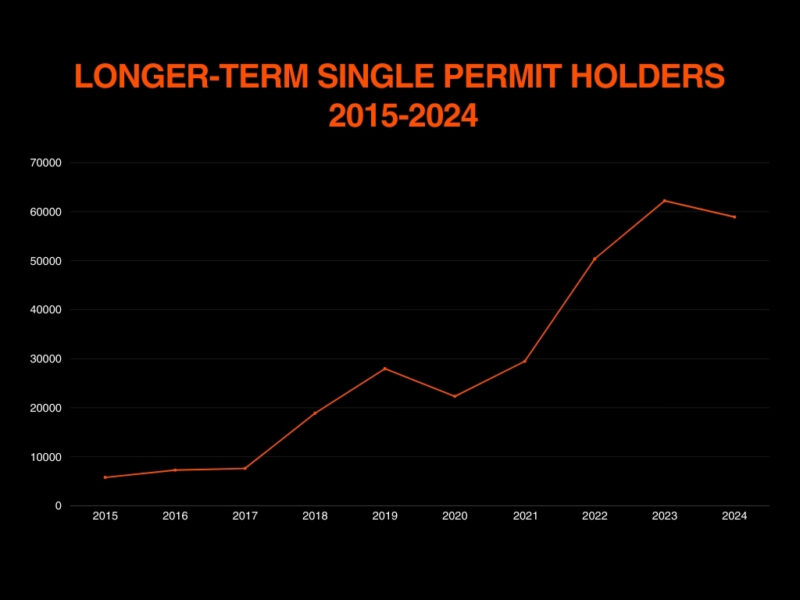
Unlike countries like Lithuania or Portugal, Malta is not actively using this system for short-term, seasonal work. Nearly 9 in 10 single permit holders in Malta are there longer-term – for 12 months or more.
The number of longer-term permit holders has been soaring since 2018, consistent with the government’s policy changes that have made the recruitment of non-EU nationals easier since 2017.
Source: Eurostat
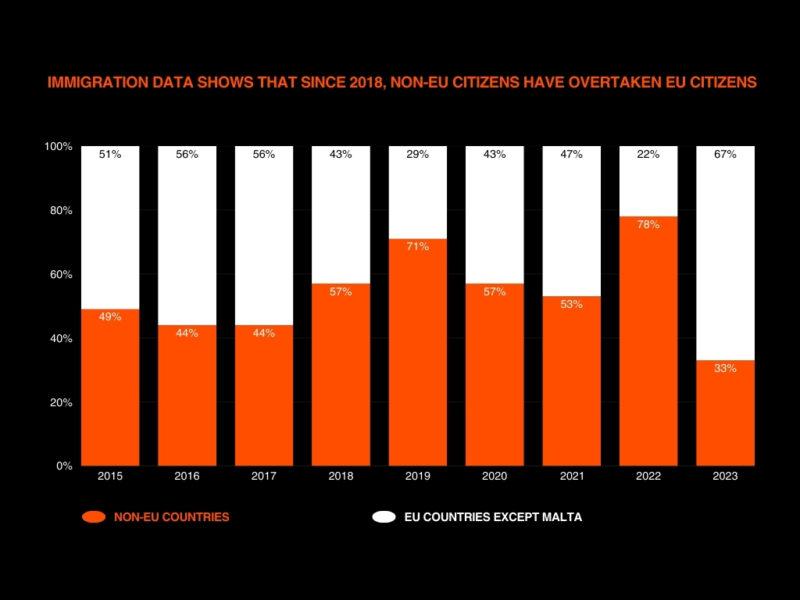
Immigration data shows how non-EU citizens overtook EU citizens. The share of EU citizens among immigrants (for any reason) further shrank during the post-pandemic recovery.
Source: Eurostat. Note: EU countries include the UK until 2020
From 2021, UK citizens need a work permit in Malta. After a post-pandemic growth, their number has been declining, with 203 new British workers in 2024.
By 2024, employment had become the main gateway into Malta for non-EU nationals, accounting for half of all new arrivals, with education representing a further quarter.
The figures below break down residence permits by purpose.
Employment
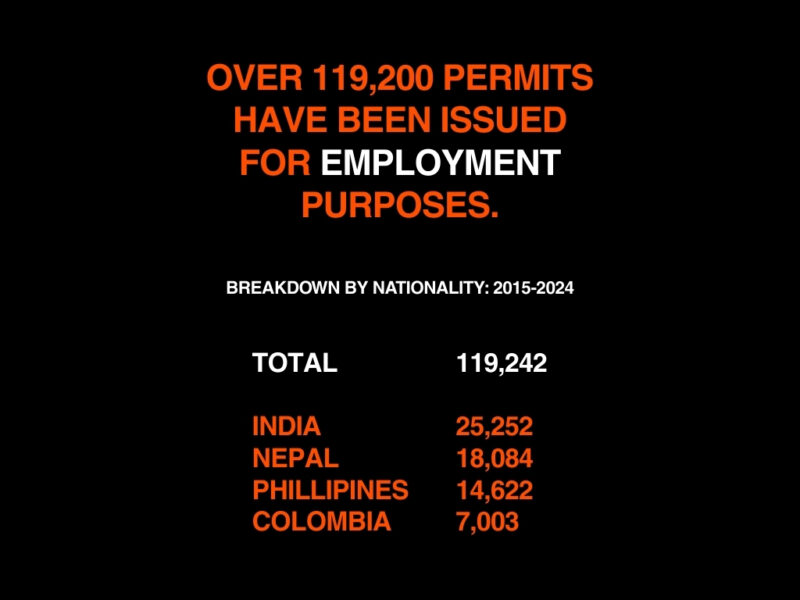
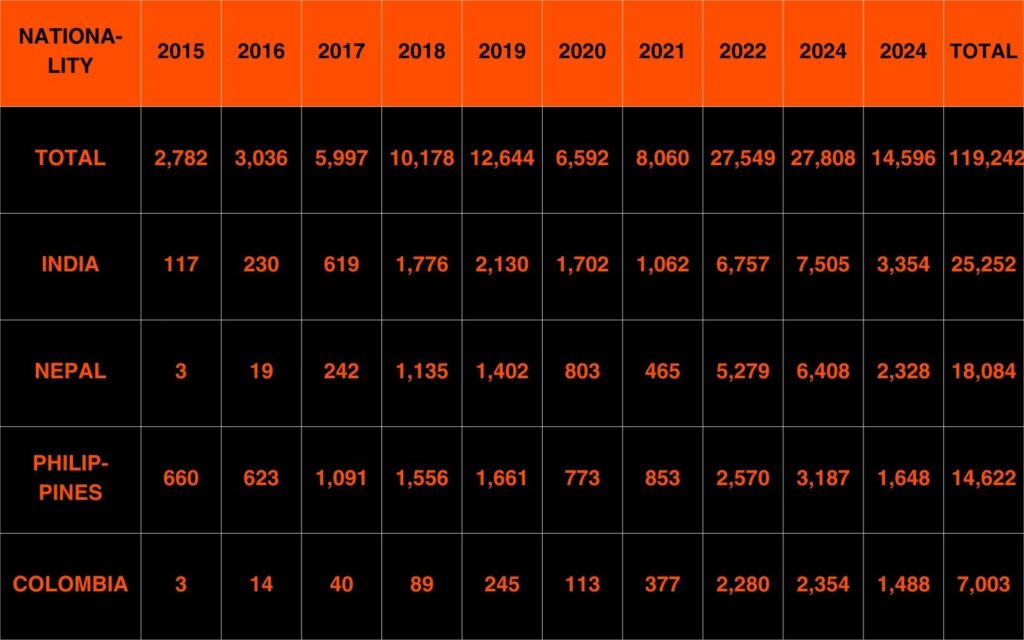
Over 119,200 first residence permits for employment purposes were issued between 2015 and 2024. This is not the same as the number of workers, as some may have left or changed their residence status.
Indian nationals received the most permits, a fifth of the total issued, followed by Nepalese, Filipino, Serbian and Colombian citizens.
Several of these nationalities are also among Malta’s most deported.
In 2024, the number of first permits was as follows.
Source: Eurostat
Top nationalities in 2015-2024
Source: Eurostat
Highly qualified individuals can obtain an EU Blue Card and reside in Malta with it.
Between 2015 and 2024, Malta issued only 27 new permits on this basis: Russians, Americans and Indians received three cards each.
Education
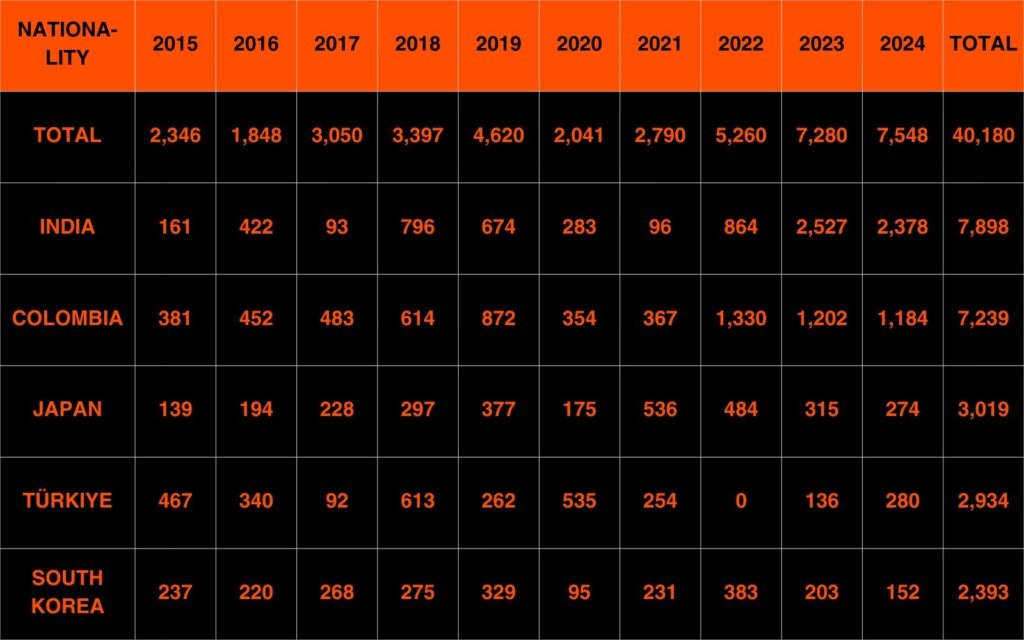
Between 2015 and 2024, a total of 40,180 residence permits were issued for educational purposes, with Indians (7,898 permits) and Colombians (7,239 permits) topping the list.
In 2015-2016, only a handful of Indians came to study in Malta, but the number shot up to hundreds in 2017 and nearly tripled between 2022 and 2023.
Hundreds of Colombians had been coming to study in Malta already in 2015-2016, but new arrivals first exceeded 1,000 in 2022.
Top nationalities of residence permit recipients for education
Source: Eurostat
Family
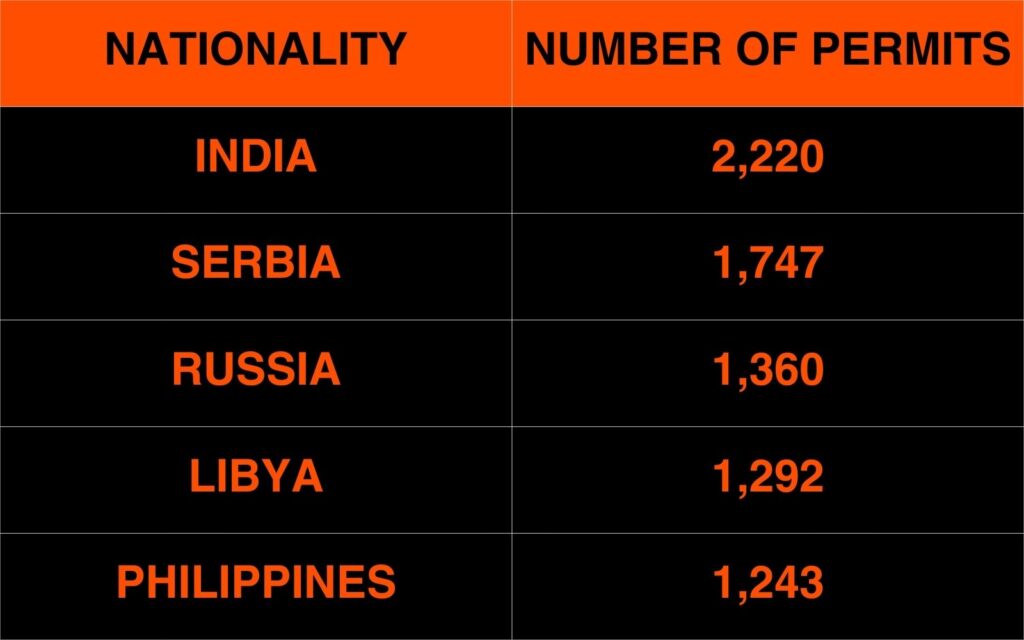
Residence for family reasons is a separate status. The number of such first permits peaked in 2023 at over 3,000. Between 2015 and 2024, the main nationalities receiving these permits were as follows.
Main nationalities of permit recipients residing for family reasons
Source: Eurostat
Most new recipients of family permits joined another non-EU citizen already living in Malta. There were almost 2,600 in 2024, with 537 non-EU citizens joining an EU citizen living in Malta (the most common nationality among these is British).
Other reasons
Residence permits can also be issued for other reasons, which include financially independent retired persons, non-asylum discretionary permissions to stay, and diplomats. Eurostat also collects data on residents with international protection statuses (refugee status and subsidiary protection).
In Greece and Italy, over half of first-time resident permit holders in 2024 applied for one of these reasons, but in Malta, the share was under 16%.
In 2015, the share of employees and people applying for other reasons (including retirement) was about equal, but employment has since overshadowed this other category.
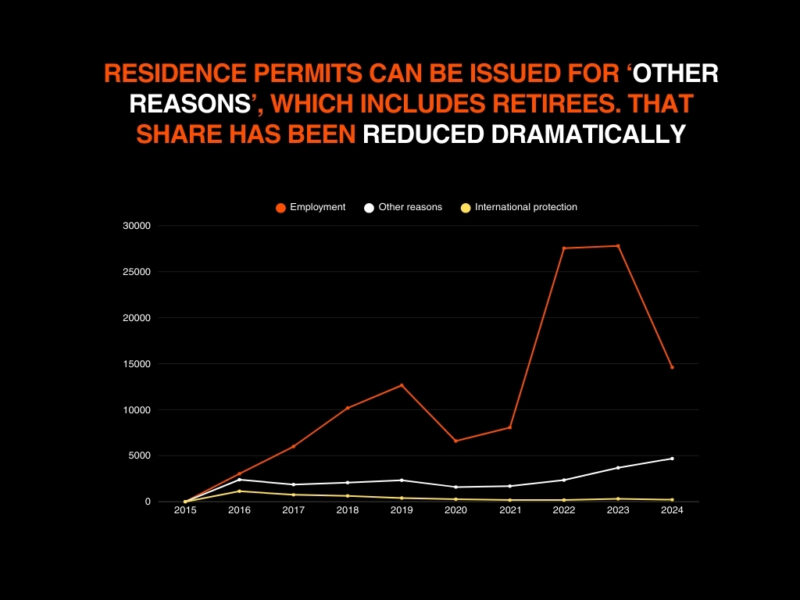
Source: Eurostat. Note: the drop in employment-based residence permits likely reflects changes in the Temporary Work Agencies legislation.
In 2020, when Brexit changed the status of UK citizens, making them third-country nationals, it was estimated that around 8,000 retired Brits were living in Malta.
The number of first permits for other reasons (including retirement) has recovered after a pandemic dip and soared in 2023 and 2024, reaching nearly 4,700.
In 2024, 4,073 residence permits were issued by Identita through the Malta Permanent Residence Programme (MPRP), the Malta Residency and Visa Programme (MRVP), and the Nomad scheme for digital nomads (the latter accounted for 1,031 of this number).
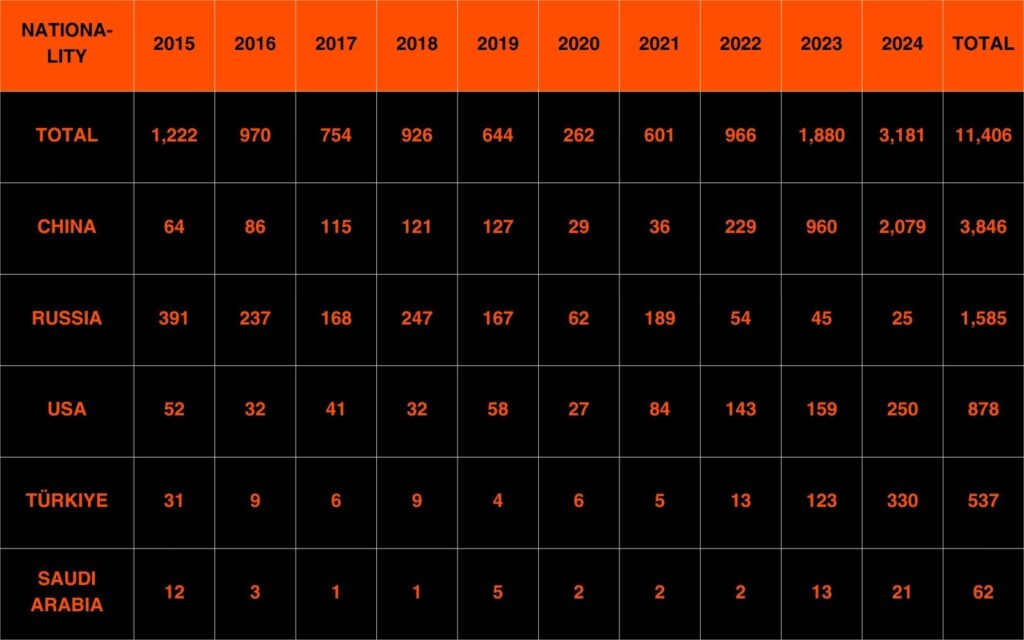
Eurostat data also contains statistics on ‘residence’ as a reason. China and Russia top the list of over 11,400 recipients between 2015 and 2024.
Top nationalities with ‘residence’ as a reason for permit
Source: Eurostat
Meanwhile, a total of 5,242 people received refugee status or subsidiary protection between 2015 and 2024, with the top nationalities being Syria and Libya. Contrary to leading politicians’ claims, the contribution of asylum seekers and refugees to Malta’s rapid population growth is minimal.
Asylum applications in Malta have been in steep decline, with the government praising this trend amid increased deportations. In 2025, Amphora Media reported on pushbacks to Libya to decrease arrivals.
In totality, this significant shift in migration policy, geared towards imported labour from non-EU countries, is reshaping towns and neighbourhoods as explored in Amphora Media’s Landscapes of Change investigation.
More to read
-
-
Environmental

Green To Grey: How Is Land Take-Up Regulated?
-
-
Environmental

Green to Grey: When Development Creeps Up On Agricultural Land
-
-
Environmental
Infrastructure, Commercial Complexes, Cemetery: Satellite Data Reveals Malta’s Largest Green-to-Grey Areas
-
-
Environmental
Green To Grey: Malta Lost Over 830,000 Square Metres Of Land To Development In Five Years
-
-
Environmental
Profit In Every Drop: The Companies Pumping Malta’s Groundwater For Free
-
-
Crime & Legal Affairs
Listen: The Trial Against Yorgen Fenech – A Podcast By Amphora Media
-
-
Politics
Open Malta: A New Political Data Transparency Platform By Amphora Media
-
-
Crime & Legal Affairs

MGA-Licensed Operator Linked To €5.86 Billion German Illegal Gambling Probe