Which of Malta’s Election Polls Was Most Accurate?

Of the three final pre-election surveys, Malta Today’s came closest to calling the split between the two main parties and the gap between them, but it leaned too heavily on third parties and badly missed the turnout.
The election brought the ruling Labour Party (PL) its fourth victory, with nearly 52% of the vote. Third parties and independents collected just over 3.5% among them.
Malta Today’s survey underestimated the PL’s performance by over 1 percentage point and was remarkably precise in estimating the performance of the opposition Nationalist Party (PN), with a difference of less than half a percentage point. However, it predicted over 5% would go to third parties and a lower turnout than in 2022. This did not happen. Earlier surveys by Malta Today predicted an even larger share for third parties.
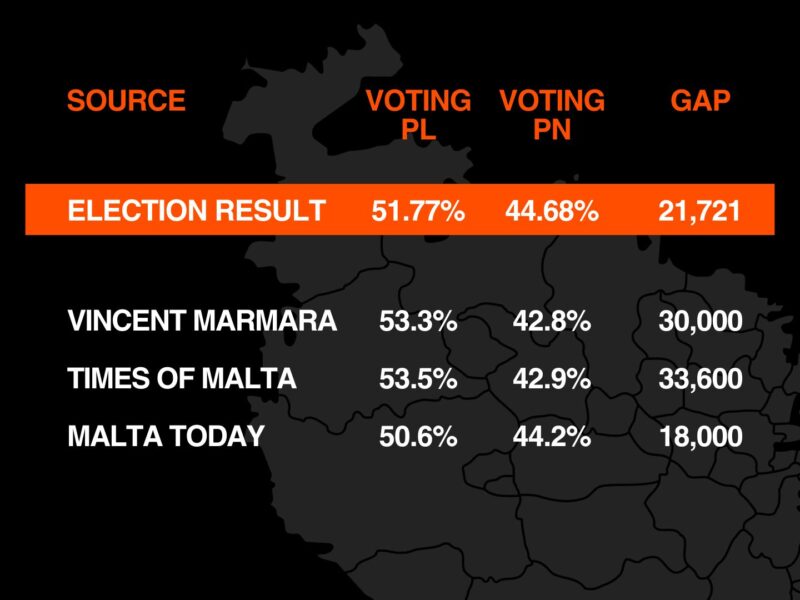
The Times of Malta overestimated the PL’s share of the vote by 1.7 percentage points and underestimated the PN’s by a similar margin. It does not look like much, but, taken together, the Times of Malta’s survey had the least accurate estimate of the gap between the two parties. The Times of Malta predicted a much larger gap in the PL’s favour, at 33,600 voters. The gap estimated in the April survey was much closer to the actual election outcome.
This survey was extremely precise in the estimate of third-party vote, placing it at 3.6%. Earlier surveys predicted a similar result.
The Times of Malta also made a very accurate prediction of the turnout, which was slightly overestimated. The turnout predicted in The Times of Malta’s 17th of June survey was 87.9% – very close to the actual figure of 87.4%.
The latest survey by Vincent Marmara also severely overestimated the gap between the two main parties, projecting it at 30,000. Accordingly, it overestimated the PL’s performance and underestimated the PN’s performance by under 2 percentage points to each side.
It was precise (within half a percentage point) in estimating the share that third parties and independents would get. Across four surveys he conducted since February, the gap was consistent and much larger than it ultimately turned out to be. Turnout predictions in surveys earlier in May were similar to Malta Today’s and much lower than the actual turnout.
All in all, it appears that Malta Today’s survey was the most precise in capturing preferences between the two establishment parties, but overestimated the protest vote (third-party vote and non-voting). The Times of Malta and Vincent Marmara’s surveys predicted a much more favourable outcome for the PL than what materialised.
More to read
-
-
Environmental

Green To Grey: How Is Land Take-Up Regulated?
-
-
Environmental

Green to Grey: When Development Creeps Up On Agricultural Land
-
-
Environmental
Infrastructure, Commercial Complexes, Cemetery: Satellite Data Reveals Malta’s Largest Green-to-Grey Areas
-
-
Environmental
Green To Grey: Malta Lost Over 830,000 Square Metres Of Land To Development In Five Years
-
-
Environmental
Profit In Every Drop: The Companies Pumping Malta’s Groundwater For Free
-
-
Crime & Legal Affairs
Listen: The Trial Against Yorgen Fenech – A Podcast By Amphora Media
-
-
Politics
Open Malta: A New Political Data Transparency Platform By Amphora Media
-
-
Crime & Legal Affairs

MGA-Licensed Operator Linked To €5.86 Billion German Illegal Gambling Probe