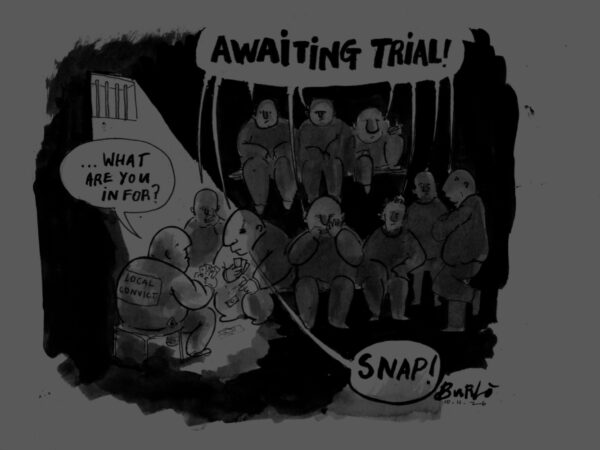
Justice Delayed, Equality Denied: How Strained Services in Malta’s Justice System Disadvantage Foreigners
By Joanna Demarco
Part two of a two-part investigation with Italian partners Prismag, supported by Journalismfund Europe and guided by Italian criminal law expert and academic Dr. Francesca Vitarelli, and journalist Inga Springe.
Key Findings:
- Sources in the field report cases of poor or no communication between migrants and the lawyers representing them in court.
- According to testimonies from NGOs, migrants and/or asylum seekers sometimes don’t know who their legal aid lawyer is and can’t contact them. Some have pleaded guilty without understanding what they were pleading to.
- All 22 of Malta’s criminal legal aid lawyers work part-time. Each is paid a flat €10,000 a year, whatever their caseload. In 2025, the Legal Aid Office oversaw 828 criminal cases, an average of 37.6 per lawyer.
- The Legal Aid Agency is recruiting 39 criminal lawyers from January, which would raise staffing hours significantly. Salaries are on lower government scales and below the national average wage of €27,240.
- No qualifications are needed to interpret in Maltese courts.
- The official list of court interpreters has no Nepali, Tagalog or Hindi, the main languages of the communities most migrant workers now come from.
- Interpretation for psychological services in prison is provided only on a case-by-case basis.
- Strained services create delays. Serious criminal cases in Malta take an average of 3,977 days to resolve, almost 11 years, according to the 2026 Rule of Law report.
*Nadia has been interpreting and mediating between persons accused of crime and players within the Maltese criminal justice system, such as police and lawyers, for years. Building trust, she says, is a skill needed to communicate effectively, to “deliver the feeling, the idea, the story, for the client.”
Nadia fit interpreting into her free time, eventually stopping when she no longer felt respected within the system. She spoke to Amphora Media on condition of anonymity, as part of its investigation into pre-trial detention and the disproportionate impact on foreign inmates who are yet to face trial and therefore still presumed innocent.
Amphora Media spoke with people in the field to understand whether Malta’s justice system and the services it provides, such as legal aid and interpretation, subject foreign nationals to systemic indirect discrimination.
A professional interpreter’s role has its rules, Nadia explained. You have to translate in the first-person as though you are the client – not “he” but “I” – and you are not allowed to speak your opinion.
Nadia explained how, across her years of experience, clients were often not given room to explain their side of the story. In some cases, clients were told to plead guilty – “depending on the lawyer” – in a box-ticking exercise of sorts.
“At this point [they’re] just trying to figure out what is happening, and the lawyer doesn’t know what their situation is. The lawyer should know all the details, and then be able to define [the argument],” she said.
Lack of Communication Between Legal Aid Lawyers and Migrants
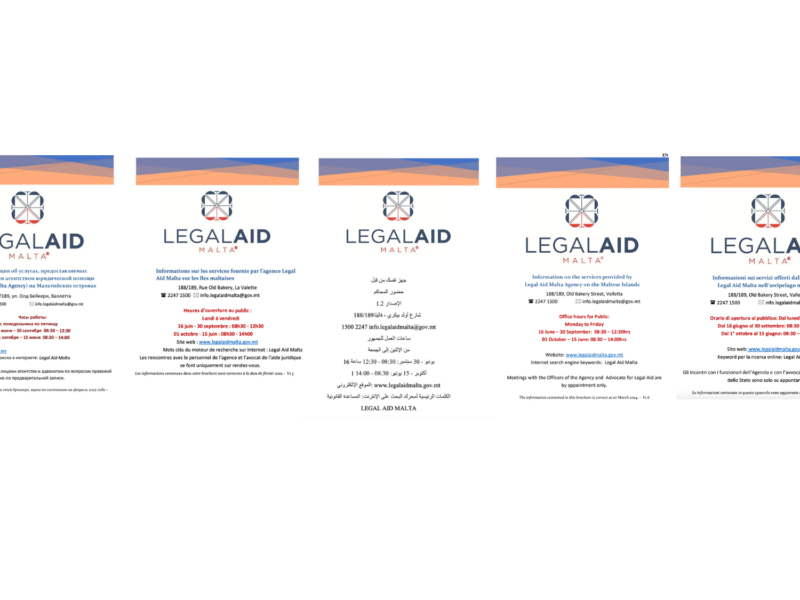
Legal aid lawyers work part-time and are paid comparatively low salaries. In 2025, the Legal Aid Office oversaw 828 criminal cases, an average caseload of 37.6 cases per year in the role. And a similar load – 403 – between January and beginning June of 2026, according to data provided by the Legal Aid Agency.
Meanwhile, testimonies from three independent sources who work with migrants within the justice and prison system in Malta detailed how communication between their clients and legal aid lawyers is often poor. They pointed to workload and the conditions the role entails as potential factors discouraging further effort.
“Our clients tell us ‘I had no idea who my lawyer was, I don’t know their name, I can’t contact them.., We have had clients who sometimes don’t even know that they’ve pleaded guilty. We’ve had clients who had no clue what they were pleading… that’s absolutely shocking for us,” Carla Camilleri, deputy director of human rights NGO aditus foundation, told Amphora Media.
Similarly, Research and Advocacy Coordinator Beth Cachia from the Jesuit Refugee Service (JRS) Malta told Amphora Media that “there’s no communication between a client and the lawyer.”
JRS Outreach Coordinator Mariosa Caruana added that poor communication undermines the “dignified aspect of sitting down and telling me how the system of court and justice works in Malta, and what is happening with my case and with my life.”
While Maltese and non-Maltese people use legal aid services, asylum seekers are likely to use it because of their financial situation.
“Private lawyers are very expensive – there’s also a certain “knowledge” (asylum seekers) might not have about who would be best. However, I think most of [the decision] relates to costs,” said Cachia.
Amphora Media filed an FOI request with the Ministry for Justice, Research and Innovation, for data on changes to requests for legal aid lawyers; however, we were told the ministry does not keep records of such information.
Part-Time Legal Aid Lawyers Face Low Salary
Legal aid lawyers, Cachia said, are “very underpaid and very overworked”.
In criminal matters, the legal aid agency employs 22 part-time lawyers: 20 for the Court of Magistrates and 2 for trials by Jury, according to information obtained through an FOI request in September. There were no full-time lawyers at the time of the request. An analysis of data provided by Legal Aid Malta based on the number of criminal cases recorded in 2025 across a team of 22 lawyers, the government body handled an average of 37.6 cases per lawyer that year.
According to the Legal Aid Malta Agency’s criminal-matters contract template, each lawyer receives yearly remuneration of €10,000 (VAT exempt), paid quarterly, plus a €180 communication allowance (inclusive of VAT).
The contract requires legal aid lawyers to provide representation to eligible clients from police interrogation or arrest through court proceedings, including appeals or the conclusion of the assigned case; be available on the daily duty roster; meet clients, prepare cases and legal documents; conduct research, attend court and make oral submissions; and keep the agency informed through reports and updates to its case-management systems, among other things.
Camilleri, who tracks progress in legal aid services annually for the Council of Europe’s Rule of Law Report, noted that some cases are more complex and take longer than others. “Shouldn’t it be based on the actual work you’ve done?” she told Amphora Media in an interview.
Despite the criminal legal aid workforce’s current small size and part-time nature, vacancies for criminal lawyers at the Legal Aid Agency suggest the agency intends to invest in full-time lawyers. The rule of law report also acknowledged the increase in the Legal Aid Agency staff budget.
The vacancies published by the agency at the end of September show it is seeking to employ 35 lawyers for criminal matters and four for criminal jury and other appeals, beginning in January.
Successful candidates will sign a “contract for service”. This establishes an independent contractor relationship rather than direct public sector employment. These positions would increase staffing hours significantly.
The new positions are paid between €21,000 and €24,000 and €22,000 and €25,000 per annum, falling between scale 15 and 13 on the government salary scale.
In comparison, junior legal officers in government are on scale 9 (€30,258 per annum, rising by annual increments up to a maximum of €32,942), while senior legal officers are on scale 6 (€35,584 per annum, rising up to a maximum of €39,162).
Court Interpreters Working Without Qualifications, Unregulated, Could Impinge on Fair Trial
Interpretation services are ad hoc and unregulated, qualifications by interpreters are not needed to fill the role, and gaps remain in the availability of key languages on official interpreter lists, Amphora Media’s investigation has found.
Malta’s courts operate in two languages, Maltese and English. Therefore, people who understand neither must rely on an interpreter to follow the proceedings against them, yet no criteria define who can serve as one.
The Court & Police Interpreters and Translation Association (CPITA), an association that started in 2012 with the objective of bringing interpreters and translators together to achieve better conditions, confirmed to Amphora Media that qualifications are currently not necessary for interpreting work in court, and that interpreters are appointed as court experts on the basis of whether “(the court) feels that they are able to carry out the said translation and/or interpreting work.”
In October 2026, Justice Minister Clifton Grima confirmed in Parliament, that under article 452 of Chapter 9 of Malta’s Criminal Code, the court can “appoint any person employed in the service of the court to act as interpreter, if it appears to its satisfaction that sufficient inquiries have been made and that no other person suitable to act as interpreter could be found.”
According to an EU Directive, interpretation should be “of a quality sufficient to safeguard the fairness of the proceedings, in particular by ensuring that suspected or accused persons have knowledge of the case against them and are able to exercise their right of defence.”
The Directive also urges member states to compile a register of independent interpreters who are “appropriately qualified.”
Aditus foundation’s Deputy Director Carla Camilleri reiterated to Amphora Media that interpreters in court are often people with a knowledge of the language and culture, but without sufficient training. Some are the sole interpreter in that language “in the whole country” and juggle different institutions.
Such a reality raises questions about the potential impinging on the “independence” of the interpreter which the directive highlights.
When it comes to issues with interpreters for the less common languages, CPITA pointed out that besides not being qualified, interpreters are also not trained. Moreover, the lack of understanding of court experience and its modus operandi creates another hurdle. The association said that these persons are usually not VAT registered, do not have a strong grasp of English, and have other full-time work.
Camilleri told Amphora Media that a lack of interpreters can “seriously affect the right to a fair trial.”
Key Languages Missing From Outdated, Court Interpretation List
In line with an EU Directive, a register of translators and interpreters “who are appropriately qualified” published by the court, shows the available languages.
However, according to CPITA, the list is outdated. In fact, an analysis by Amphora Media shows that one interpreter on the 2026 list passed away in 2022.
An analysis of the list shows that English, Italian, French, Russian, and Arabic have the most listed interpreters.
Meanwhile, the list omits key languages connected to communities that are becoming increasingly common within the Maltese population. These include Nepali, Filipino/Tagalog and Hindi; the major languages among the Nepalese, Filipino and Indian communities – from which most migrant workers now come.
Other key languages not included in the official list include Urdu, Vietnamese, Tamil, Farsi and Albanian.
According to an interpreter currently working in Malta’s courts, who chose to speak to Amphora Media on condition of anonymity, the system struggled to keep up with the influx of nationalities moving into Malta from 2015 onwards.
The interpreter said that in a situation where gaps in language availability occur, the interpreters “start searching through connections with communities.”
He also said that, in his experience, magistrates and judges make it a point to ensure the person requiring the interpreter has understood, and they postpone sittings if one is not available.
Such postponements, intended to meet fair trial standards, show how limited resources contribute to the court backlog. Malta has one of the slowest justice systems in the EU. According to the 2026 Rule of Law report on the country, criminal cases with a potential sentence of over two years take 3,977 days to resolve, almost 11 years.
CPITA noted to Amphora Media that when sittings are deferred and interpreters are not advised, they could travel to court for nothing, and are not paid.
They also highlighted the lack of interpreters in specific languages, overlapping of sittings and the lack of roster for Maltese/English interpreters as common hurdles experienced by the courts.
CPITA said that they have experienced difficulty in discussing issues with different administrations, saying that “all requests fall on deaf ears and are given the cold shoulder.”
Interpretation for Psychological Services in Prison Provided on Ad Hoc, Case-by-Case Basis
Data obtained by Amphora Media from the Home Affairs and Security Ministry on the Forensic Unit, a specialised unit within Mount Carmel for inmates needing treatment for psychiatric care, shows that pre-trial detainees make up the majority of admissions.
The Correctional Services Agency told Amphora Media that it provides interpretation for psychological services in prison on an ad hoc basis, depending on the detainee’s linguistic needs and “the availability of appropriate resources.”
“The specific language support provided is determined by the individual circumstances of each case and operational feasibility,” it said.
The agency also said it is in the process of signing an agreement with an international translation service; however, it did not specify when the agreement would be completed or the service’s name.
Amphora Media sent questions to the Minister of Home Affairs and Security, Glenn Bedingfield, the Minister for Justice, Research and Innovation, Clifton Grima, the Minister for Equality and Civil Rights, Rosianne Cutajar, the Legal Aid Malta Agency and The Attorney General’s Office.. No replies were received at time of publication. Amphora Media also requested an interview with the Legal Aid Malta Agency. The emails were not responded to.
Sabrina Zammit and Julian Bonnici contributed to this investigation with research support and editorial guidance.
More to read
-
-
Crime & Legal Affairs

In Malta’s Overcrowded Prison, Foreigners Make Up the Overwhelming Majority of Long-Term Pre-Trial Detainees
-
-
Politics

Malta Will Charge Tourists €213 Million; Most Will Be Spent On Marketing Malta To More Tourists
-
-
Politics
Malta’s Bus Fees for Foreign Workers Could Lead to EU Recovery Fund Cuts
-
-
Politics
The Economic Contribution of TCNs in Malta