17 Black, ElectroGas And 16th October: Matthew Caruana Galizia Details Daphne’s Final Investigation
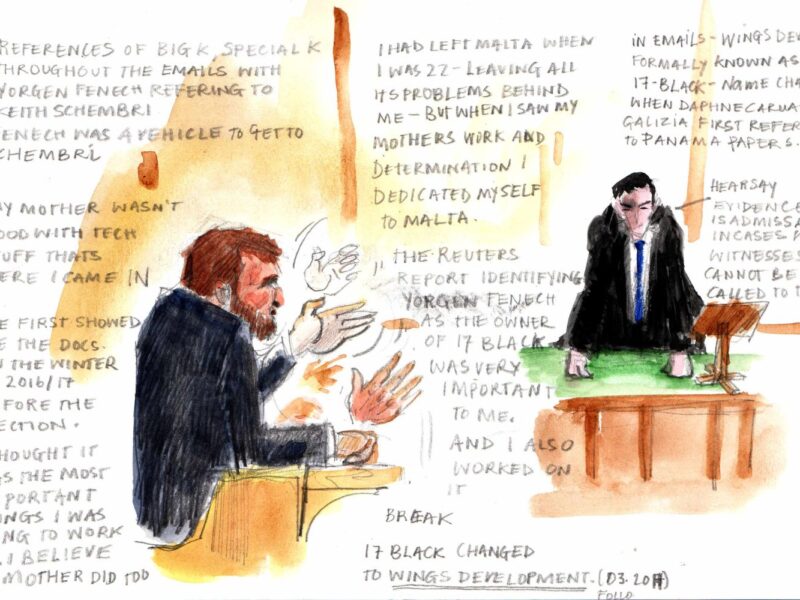
Jurors heard how Daphne Caruana Galizia uncovered 17 Black and that Yorgen Fenech was its owner – and came into possession of a treasure trove of documents from ElectroGas.
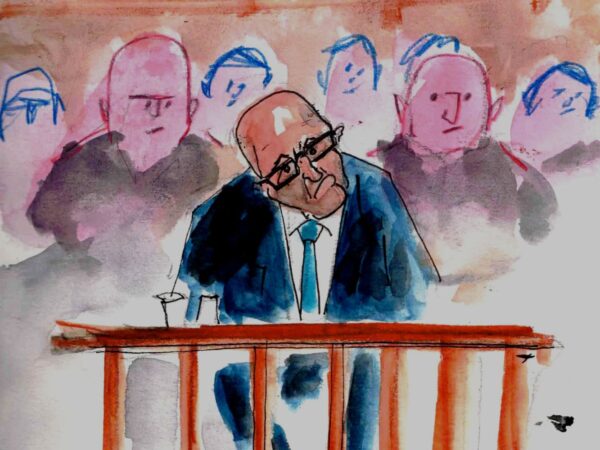
Over a sitting repeatedly interrupted by points of law and two contempt fines, Matthew Caruana Galizia, Daphne’s son, described a period of roughly two years in which he and his mother worked together on the Panama Papers leak and on a separate set of internal ElectroGas documents. This effort continued after her assassination in October 2017.
Fenech is on trial for complicity and criminal association in Daphne’s murder. He has pleaded not guilty.
The two of them began working in parallel in 2015, when Caruana Galizia began processing the Mossack Fonseca material, as part of the International Consortium of Investigative Journalists’ Panama Papers investigation, and found Maltese names in it.
The leak, he stressed, was live, meaning ICIJ received data on a rolling basis. The material he was receiving stopped around 15th December 2015, when uploads were halted to allow journalists to work on what was already in the system.
“Without the leak, most of us would have never known; we wouldn’t be here today,” he said.
Daphne was not formally part of the team – and worked with an Australian journalist on the material. There were no Maltese partners in the investigation, and, given the names mentioned, Caruana Galizia felt the need to pass on the information to Daphne.
He recalled an incident on 18th January 2016, during a libel hearing in a defamation case brought by Konrad Mizzi and his wife against his mother. As Mizzi was leaving the courtroom, he said she remarked to him that his money was hidden. From that point, “the cat was out of the bag”.
Jurors were shown Daphne’s first blog post, published on 22nd February 2016, which hinted at the Panama material and referenced New Zealand. The Panama companies of Keith Schembri and Konrad Mizzi were placed inside New Zealand trusts, an additional layer of secrecy. The Panama Papers were published on 3rd April 2016.
The prosecution then took the witness to a message from Daphne.
In the message, she asked him to confirm whether two companies, 17 Black and Macbridge, both in the UAE, appeared in the Panama Papers leak, referring to an email sent by Nexia BT partner Karl Cini in December 2015. At that point, he had not heard of them – and the Panama Papers data (as it had been processed) had not extended beyond that point.
After Daphne’s murder, more data from the leak was processed, and the email his mother had been referring to was discovered. “Everything in her message turned out to be true,” he said.
Sent by Cini to an employee of the Panama law firm and copied to a lawyer assigned to the two companies, the message described Tillgate and Hearnville, Panama companies owned by Schembri and Mizzi, as being used for holding or operational purposes across maritime, fisheries, and gaming interests. 17 Black and Macbridge, registered in Dubai, were the listed target clients.
Both men have consistently denied wrongdoing in connection with the Panama structures. Schembri said in this trial that the structure was created to protect his business interests.
The search for the owner of 17 Black became, in his words, an “all-consuming mission”. He travelled to the UAE more than once. On the last trip, in November 2019, he took a taxi to a company registry in Ajman where he suspected 17 Black was registered.
He was refused entry by a security guard. He appealed to a member of staff, explaining that the company was linked to his mother’s murder. She took him to an office, where he heard her arguing with a colleague. He was then told to go home.
That changed once Fenech was arrested soon after. On Fenech’s devices, disclosed to him as parte civile during the compilation of evidence, was the certificate he had been hunting for.
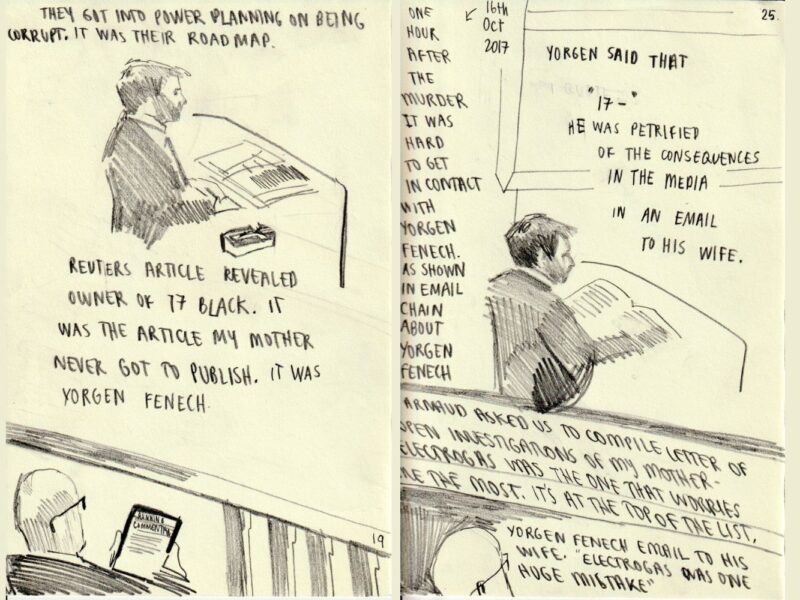
The court was then shown a board resolution recovered from those devices, dated 29th February 2016, recording Fenech as shareholder and director of 17 Black. This was less than a week after Daphne’s first blog post on the Panama material on 22nd February 2016.
ElectroGas
Caruana Galizia said that on a trip to Malta in late 2016 or early 2017, his mother told him she was receiving emails from inside ElectroGas. This consortium had won the tender to convert Malta’s power generation from heavy fuel oil to gas in 2013.
There were thousands of documents, she said, and she needed a secure way to receive them, which he helped with. The two of them had planned an ElectroGas investigation on a scale comparable to the Panama Papers. It was never published.
“It was like a portal opened up, and I could see into hell,” he said, adding that they regarded the tendering process as “corrupt”.
His account of what he saw in the documents drew repeated objections. Those documents and emails, he said, showed the company in financial difficulty, with complaints about unpaid bills. Fenech was in correspondence and a focus of key conversations.
He took jurors through a series of emails. This included exchanges about how to respond to her blog posts, namely on ElectroGas’ financial troubles. Those financial issues were confirmed in the email exchange.
One email, he said, concerned the consortium’s inability to meet a loan deadline of 30th September. In another, a member of the consortium asked Fenech whether telling “big K” on Monday about a purchase would buy them some time. Caruana Galizia told the jury that references to “Big K” in the emails were to Keith Schembri, at which point the judge instructed him not to interpret the documents.
Another, sent to Fenech by an ElectroGas executive, discussed a possible reaction to a blog post his mother had published in May 2017 detailing the financial issues.
That post, published on 25th May 2017, reported trouble at the ElectroGas power station, that the company was not paying creditors or salaries, and that sources said it was still not producing energy and was operating at a fraction of capacity.
The leaked data showed the company having trouble paying invoices, and the internal emails that followed confirmed her reporting. He added that the consortium was concerned about the effect media coverage was having on its ability to secure additional loans.
An FIAU report, which focused on kickbacks from the ElectroGas project and was revealed by The Malta Independent, recorded that 17 Black was to receive payments as part of the scheme.
An email from the same week, dated 26th May 2017, circulated the FIAU material internally, noting that 17 Black was now out based on a leaked report and linking it to the earlier story.
Another email from Fenech to his wife, listing the reasons for his troubles. Point 5 was ElectroGas and “17-“.
One of the first stories from a consortium brought together after Daphne’s murder was that ElectroGas had notified the government it was in default of its contract because it had run out of money.
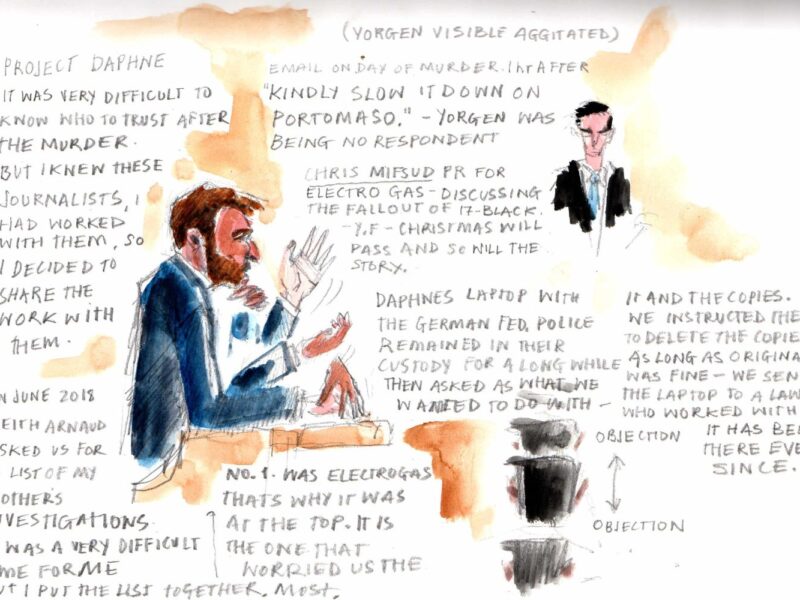
“I didn’t know who to trust after the murder,” he said.
The Last Day
Caruana Galizia experienced his mother’s murder first hand. He was in Malta on 16th October, at home with Daphne. He woke up that morning after his father had left the house, opened his laptop and got to work.
“I didn’t even notice the time pass. My mother made me some lunch. She saw I hadn’t eaten anything. She had a phone call and left the house. We agreed I would use the car that evening. She came back in. She had forgotten my dad’s chequebook – her account was frozen at the time, and he would sign cheques she could use. Then she left for the last time.”
“I was working on my programming and listening to music. And soon after she left the house, I heard an extremely loud explosion.”
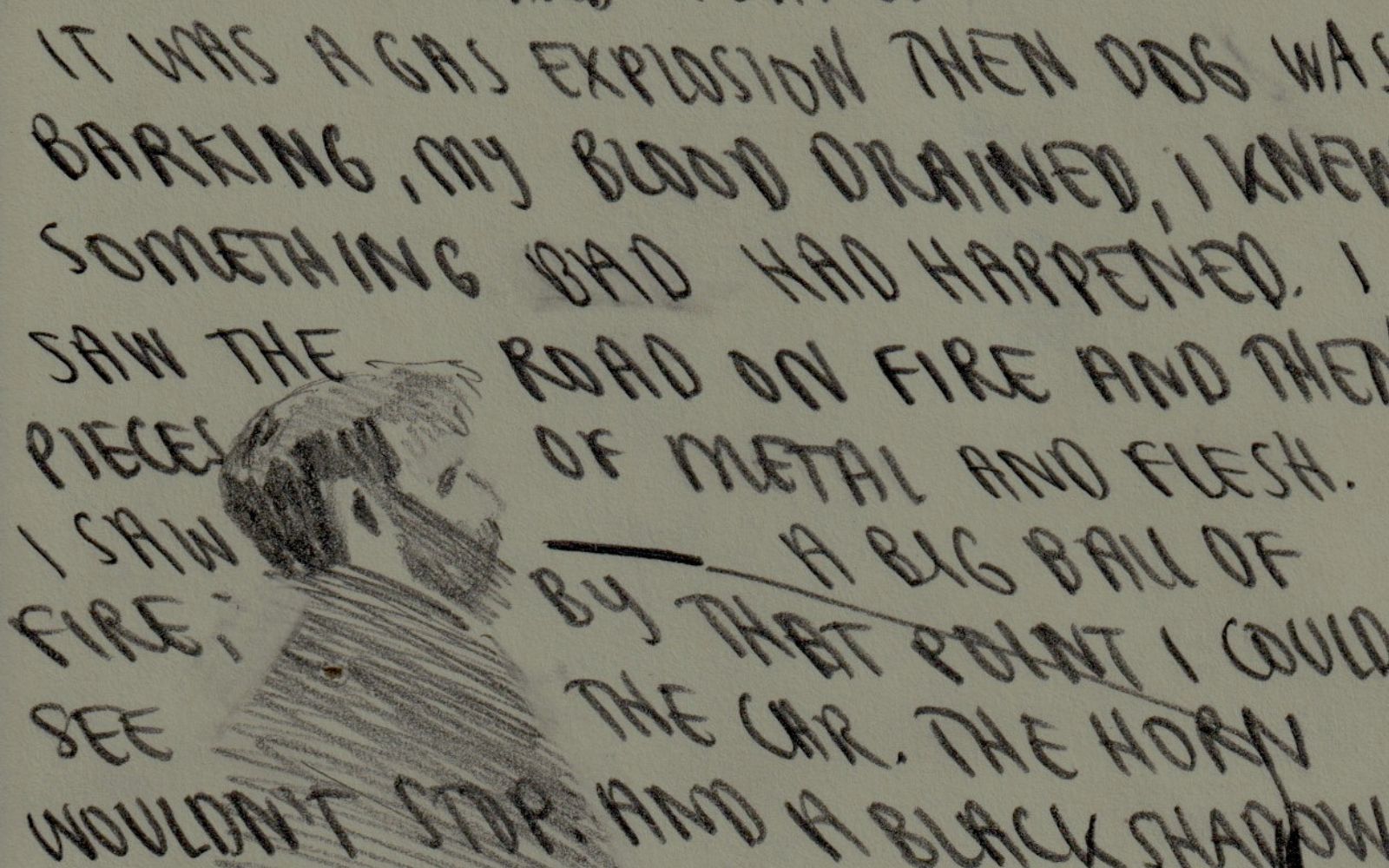
His first thought was a gas tank. A split second later, he opened the front door. He felt the sunlight. The dog was barking. “I just felt blood draining from my body because I felt something terrible had happened, even though I didn’t know what,” he told jurors.
He went down the lane towards the main road, walking faster and faster until he was running. He saw a tall column of smoke, like “burning tyres”.
“The road was on fire. I saw pieces of metal, then pieces of flesh. I still did not understand what was happening. My eyes followed the smoke, and I saw a huge ball of fire in the middle of a field. I ran towards it. The horn was going off. It just wouldn’t stop.”
“I looked through the fire and saw a black shadow in the car. I thought, “That’s my mum”. I looked around to see if there was something I could use to open the door. Then I saw a leg on the ground. I thought: for nothing, it’s over.”
“As terrible as it sounds, I was hoping it was someone else’s car.”
A woman and a young girl on the road asked him what to do. He told them to call the police. He never saw them again. A police car arrived. They took out a fire extinguisher. He was shouting at them to use it.
“One of them was crying. He told me it was useless”.
His memories beyond that moment are faded. More police and firefighters arrived. He sat down on the road, barefoot, trying to contact family members before they found out via news reports.
“I got through to my little brother. I told him there was a bomb. I didn’t have the heart to tell him there was no hope”.
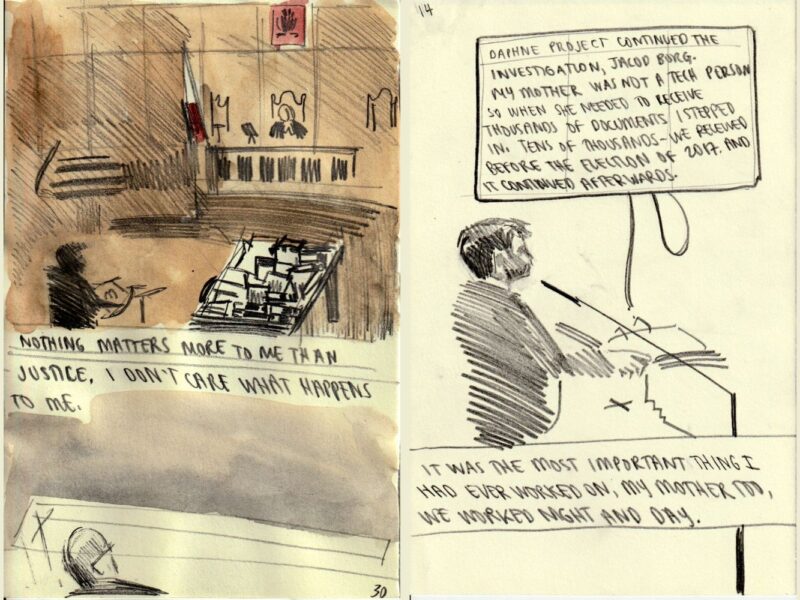
Before that point, he told the court, he had been a regular person. He went to work, took holidays when he had leave, spent time with his friends. After the murder, all of that was forgotten. “My work became the investigation. It became justice.”
“I hardly had a day of rest and neither did anyone else in my family. We felt an enormous sense of responsibility to ensure there was justice. The work had to be done now or never. We had to make it our mission.”
“I put all of my energy into this. This is not something an ordinary person should do – but we couldn’t just sit back and expect things to happen on their own. We had to build a path forward. We were stretched to the bone. This wasn’t months – but years. Our efforts created progress. So I think we did the right thing.”
“The most important thing in my life is justice, and that’s it. My father once said he was worried about what I was doing. I told him I didn’t care as long as we get justice. Once we get that, I can disappear – nothing else matters to me.”
Daphne’s Laptop
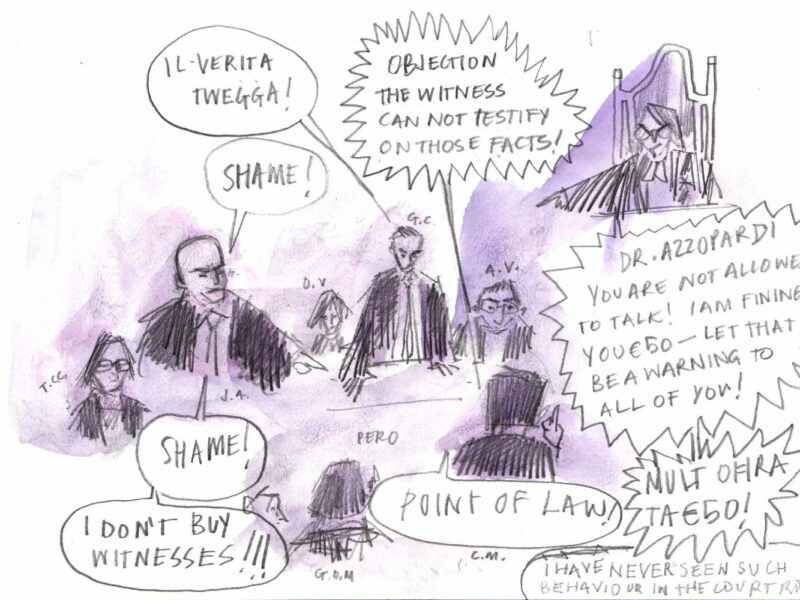
Caruana Galizia confirmed that Daphne’s laptop was taken to the German Federal Police, who offered the Maltese authorities the opportunity to send questions and requests for data to be searched.
It remained in the German Federal Police’s custody for an extended period. Eventually, they asked the family what they wanted to do with the original and copies of the data extracted from the laptop. The family informed them that they could delete the copies as long as the originals are maintained.
The originals were handed over to the family’s lawyers, where they have remained ever since.
Lawyer Jason Azzopardi, appearing for the Caruana Galizia family, was fined €50 twice during the sitting, over remarks following the defence team’s objections.
“Shame,” he said following a Mercieca interjection dismissing what Daphne told her son as opinion. “I’m not the one who bribes witnesses,” he added.
The trial continues tomorrow.
More to read
-
-
Environmental

227 Million Litres For Free: Polidano Companies Top Malta’s Groundwater Users
-
-
Environmental
Profit In Every Drop: The Major Industries
-
-
Environmental
Profit In Every Drop: The Companies Pumping Malta’s Groundwater For Free
-
-
Crime & Legal Affairs
Listen: The Trial Against Yorgen Fenech – A Podcast By Amphora Media
-
-
Politics
Open Malta: A New Political Data Transparency Platform By Amphora Media
-
‘All Roads Lead To Keith’: The Defence’s Case In The Trial Against Yorgen Fenech