Profit In Every Drop: The Companies Pumping Malta’s Groundwater For Free
Malta has a unique relationship with water. Water surrounds the islands, but it is limited to the 316 km² land area. Malta has no natural lakes or rivers, making groundwater a precious – and crucially, free – resource. Water stress, the demand for water and competition among its users, is extremely high in Malta, according to international standards.
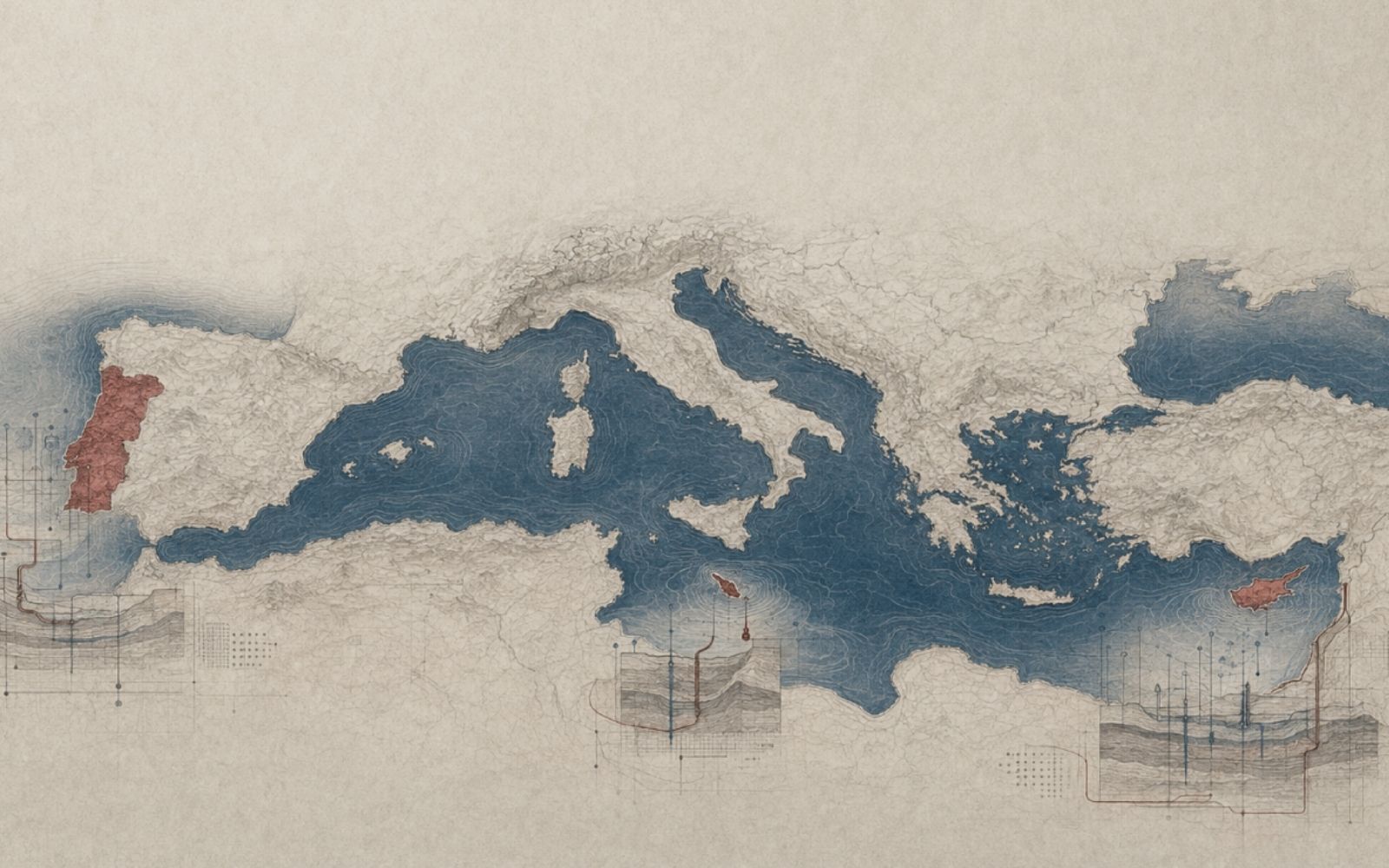
A cross-border investigation covering Malta, Cyprus and Portugal shows that three of the EU’s five most water-stressed countries systematically tolerate over-exploitation by for-profit companies.
“Turn off the water while you brush your teeth and save up to 15 litres a minute. That’s up to 760 litres a week for a family of four,” a government campaign says. Meanwhile, the largest groundwater user drew at least 250,867 litres per week for a sprawling estate.
In 2023, Malta used 35 million cubic metres, or 35 billion litres, of groundwater. 13 million cubic metres were used for the public water supply; over 17 million for irrigation in agriculture and forestry; and roughly 1.5 million for manufacturing and services.
“Over-abstraction has resulted in the intrusion of saline waters in the main mean sea level aquifer systems, contributing to the gradual salinisation of these important groundwater reserves,” a government green paper, published in 2023, said.
To address unsustainable use, the green paper proposed pricing and quotas for water users. Since then, nothing has happened, except for unspecified “internal discussions”, according to the Environment and Resources Authority (ERA).
The registered commercial share is another question. Official records provided by ERA to Amphora Media show that more than 63% of all registered commercial groundwater boreholes are providing “no data”.
“What is probably happening is that most operators across the board would have one registered borehole and one or more, which is not. This so that, if the government decides to charge a tariff on the water pumped from the registered borehole, they will shift pumping from one borehole to another and continue as usual,” water treatment engineer and hydrologist Marco Cremona told Amphora Media after reviewing the data.
He is convinced that the dataset is incomplete: “I know of a number of commercial operators that pump a lot of water but are not on the list. For example, there is no information on the groundwater being pumped by commercial laundries – who also are big users of water,” he said.
Data indicates a rise in groundwater abstraction (more colloquially, extraction) by commercial operators over the period.
In 2020, total consumption stood at 459.9 million litres. By 2023, it had climbed to 656.8 million litres. In 2024 (the most recently available data), the figure dipped to 605.3 million litres, below the 2023 peak but still well above 2020 levels.
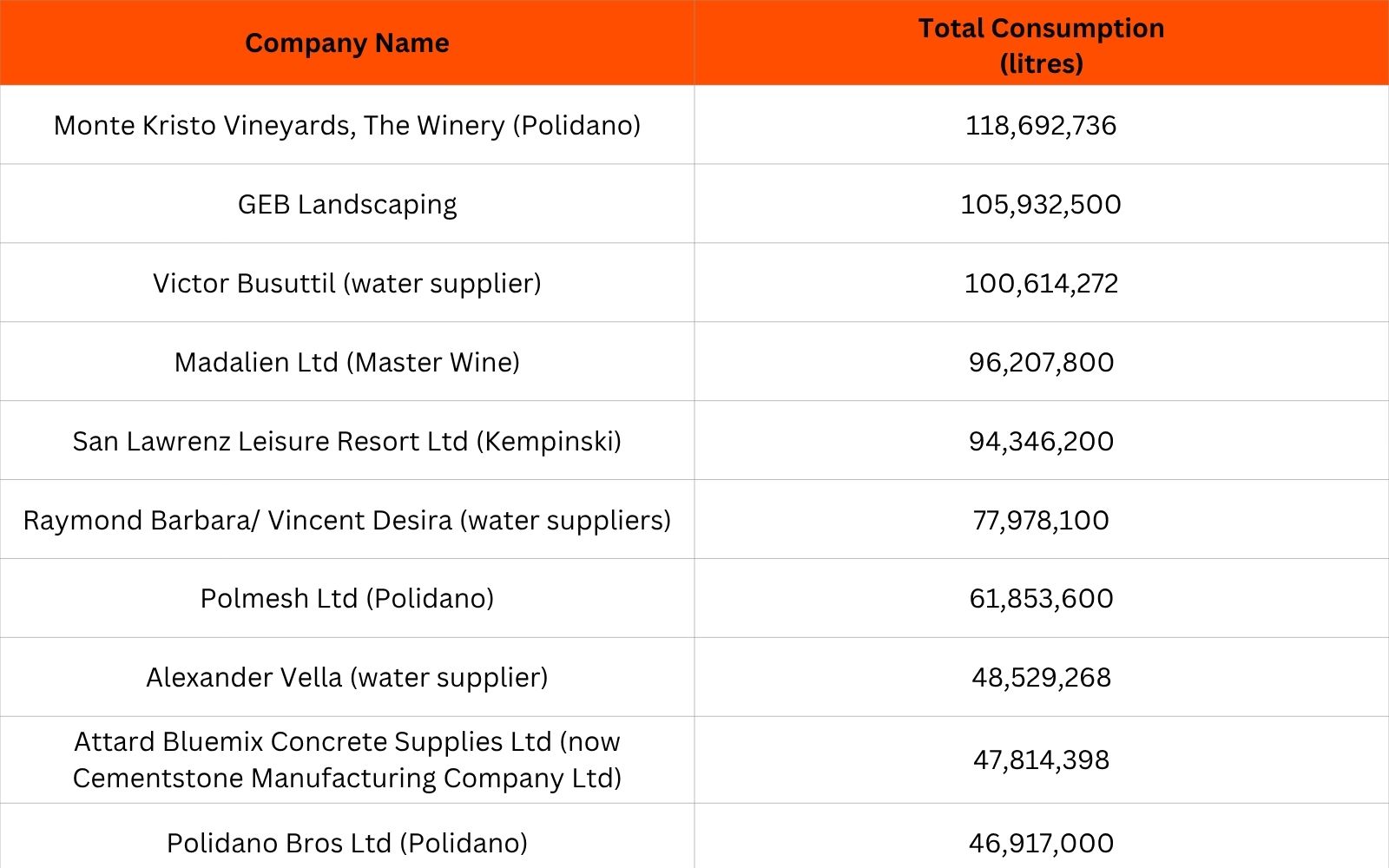
THE TOP GROUNDWATER ABSTRACTORS
Over-Abstraction Can Make Groundwater ‘Unusable For Decades’
A report by the European Environment Agency has found that over-abstraction causes salty water to mix with freshwater sources, particularly in Mediterranean countries like Malta, which could render groundwater “unusable for decades.”
It can also damage agricultural yields. Groundwater supplies over 80% of the Maltese agricultural sector’s needs, costing these users around €0.25 per cubic metre to deliver it where it is needed.
Marsa Sports Club, itself a major water user with over 18 million litres abstracted in 2020-2024, told Amphora Media that increasing salinity has been demanding more investments: “as the quality of the groundwater has deteriorated over the years through increasing salinity, the Club has been obliged to invest significant funds in adapting its facilities,” the club said. “These investments have been funded from the Club’s limited resources.”
The EU has set objectives to restore and protect the water cycle from source to sea by recognising water scarcity as a priority in the European Green Deal and various strategies, stating that “groundwater needs to be protected from pollution and over-exploitation”.
The bloc’s Water Resilience Strategy calls for action to address “structural mismanagement of water due to both legal and illegal over-abstraction”.
Countries must “increase their efforts to register and control all abstractions”, and a pan-EU review of the strategy is promised in 2027. A 2025 Commission recommendation calls on countries to “apply appropriate water pricing to ensure the efficient use of water” and “adopt sufficiently dissuasive sanctions for illegal, unregistered or non-permitted water abstractions and discharges”.
None of this has stopped the government of Malta from allowing commercial operators to benefit from free groundwater abstraction, as long as they own boreholes.
Spokespersons of the government authorities contacted for comment did not reply to Amphora Media’s questions. The European Commission’s spokesperson told the investigation team that in principle, “Member States are required to control abstractions of fresh surface water and groundwater” including “a requirement for prior authorisation and the maintenance of a register or registers of water abstractions”, but “Member States may exempt from these controls any abstractions that ‘have no significant impact on water status.”
“There is some room for manoeuvre, and member states have been overusing this exemption now for years,” says Claire Baffert, water expert at the WWF European Policy Office.
How the free water economy works
The arrangement is simple: whoever owns a borehole pumps it for free.
Based on ERA data obtained by Amphora Media, Cremona compared extraction data across seasons and noted that summer abstraction is 29% above the annual average.
“A substantial part of this water is pumped by bowser operators who sell their water to hotels, for landscaping, for the filling up of swimming pools etc. In comparison, the pumping in winter (the wet season in Malta) goes down to 22% below the annual average,” he said.
Non-potable water, called second-class water, can be used for toilet flushing, laundry, cleaning and irrigation. This water would cost €0.093 per cubic metre for agricultural or industrial purposes, or €0.932 per cubic metre for building or other applications, if it was purchased from the Water Services Corporation.
“Some commercial operators have reverse osmosis plants operating on groundwater, as an alternative to buying town water. In this situation, we are looking at three costs:
- the cost of pumping it from the ground to the surface – which is a relatively minor cost;
- the cost of the treatment process itself (both in capital expenditure and operating costs);
- and finally, there’s the discharge cost of the reverse osmosis reject.
Notwithstanding these costs, it is still cheaper than buying public water,” Cremona said.
Dr Julian Mamo, a lecturer at the University of Malta working on water resources management in Malta, says that the cost of pumping, or lifting, groundwater cannot be considered negligible for sectors with lower profit margins such as agriculture.
“In a country like Malta, where in the past our ancestors had to live with water scarcity, people then generally used water efficiently. Today this may not be the case for everyone, for sure. But generally, full-time farmers continue to use water efficiently because of the effort required to obtain this water,” he said.
“It’s the cumulative impact of all those abstractions that matters, and if none of those is monitored, then you end up in a situation where there is just too much water abstracted without everyone taking note of that,” WWF’s Baffert says. Yet Malta’s commercial sector, responsible for 16% of private abstractions as of 2023 and growing, continues to pump for free.
Read the second part of our investigation, looking at the companies and industries drawing the most free groundwater in Malta, here.
This investigation was developed with the support of Journalismfund Europe.

More to read
-
-
Environmental

Green To Grey: How Is Land Take-Up Regulated?
-
-
Environmental

Green to Grey: When Development Creeps Up On Agricultural Land
-
-
Environmental
Infrastructure, Commercial Complexes, Cemetery: Satellite Data Reveals Malta’s Largest Green-to-Grey Areas
-
-
Environmental
Green To Grey: Malta Lost Over 830,000 Square Metres Of Land To Development In Five Years
-
-
Crime & Legal Affairs
Listen: The Trial Against Yorgen Fenech – A Podcast By Amphora Media
-
-
Politics
Open Malta: A New Political Data Transparency Platform By Amphora Media
-
-
Crime & Legal Affairs

MGA-Licensed Operator Linked To €5.86 Billion German Illegal Gambling Probe